🚨 Why Leadership Longevity Can Become a Business Risk
🚨 Why Leadership Longevity Can Become a Business Risk
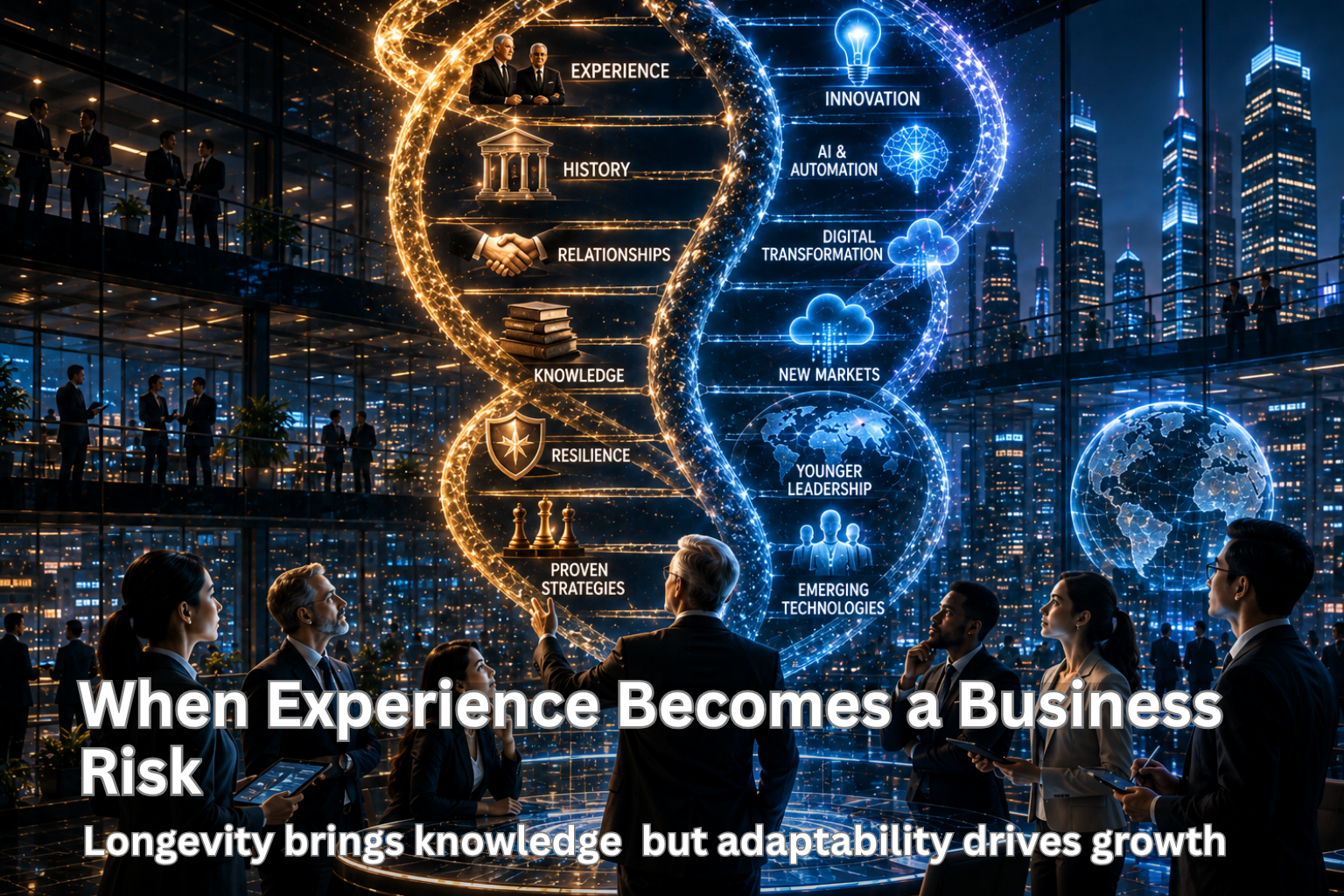
Long-serving leaders can bring stability, experience and valuable institutional knowledge to an organisation. 🧠 But when leadership longevity goes unchallenged, it can also become a significant business risk. ⚠️
In today’s rapidly changing business environment 🌍, organisations need leaders who can continuously adapt, challenge established thinking and prepare their businesses for what comes next. 🚀
Experience is invaluable but time in a leadership position should not automatically be equated with continued effectiveness. 🎯
🧭 The Value and Risk of Long-Term Leadership
Leadership longevity is not inherently a problem. In fact, experienced executives can provide significant advantages:
✅ Deep knowledge of the organisation and its customers
✅ Strong relationships with employees, clients and
stakeholders
✅ Valuable understanding of company history and culture
✅ Experience navigating uncertainty and change
✅ Established networks and industry
relationships
However, the longer someone remains in the same position, the greater the possibility that established habits, assumptions and approaches become difficult to challenge. 🔄
The risk arises when experience starts to replace curiosity, innovation and adaptability. 💡
⚠️ When Experience Becomes Complacency
One of the biggest risks associated with leadership longevity is complacency.
A leader who has been successful for many years may naturally rely on strategies that worked in the past. But markets evolve. 📈 Customer expectations change. Technology advances. 💻 Competitors emerge. 🏆
What worked five or ten years ago may no longer deliver the same results today.
Leaders therefore need to continually ask:
“Are we succeeding because our strategy remains effective or because the market has not yet exposed its weaknesses?”
This distinction can be critical. 🎯
🔄 The Danger of “We've Always Done It This Way”
Long-standing leadership teams can unintentionally create environments where traditional approaches become difficult to question.
Decision-making can become predictable. New ideas may receive less attention. Employees may become reluctant to challenge senior leaders who have held significant influence for many years. 🤐
Over time, this can create strategic inertia.
A healthy organisation should encourage constructive challenge at every level. 👥 Leaders need people around them who are prepared to ask difficult questions, challenge assumptions and identify emerging risks. 🔍
Without this challenge, organisations can become increasingly comfortable while their external environment becomes increasingly competitive. ⚡
👥 Succession Planning Should Start Early
Leadership longevity also highlights the importance of effective succession planning.
Too many organisations only begin thinking about succession when a senior executive announces their departure. ⏳ By then, there may be limited time to identify, assess and prepare potential successors.
Effective succession planning should be an ongoing process. 🔄
Businesses should continually consider:
🔹 Who could step into critical leadership roles?
🔹 Which internal leaders are ready for greater responsibility?
🔹 What capabilities will the organisation need in three to five
years?
🔹 Where are the gaps within the current leadership team?
🔹 Is the organisation developing its future leaders today?
A strong succession strategy creates resilience and reduces dependence on individual executives. 🛡️
🌱 Leadership Renewal Can Strengthen a Business
Leadership renewal does not necessarily mean replacing experienced executives.
Sometimes, the answer is to introduce new perspectives alongside established expertise. 💡
Bringing new leaders into an organisation can provide:
✨ Fresh strategic thinking
✨ Different industry perspectives
✨ New approaches to
technology and transformation
✨ Greater challenge and debate
✨ Broader leadership capability
✨ New energy and momentum
The strongest leadership teams often combine institutional knowledge with fresh thinking. 🤝
Experience tells an organisation where it has been. 🗺️ New perspectives can help determine where it should go next. 🚀
🏛️ The Board Has an Important Role
Boards and shareholders have an important responsibility in assessing whether leadership remains aligned with the organisation’s future requirements.
Rather than focusing solely on past performance 📊, boards should consider whether senior leaders possess the capabilities needed for the challenges ahead.
Important questions include:
❓ Is the leadership team still challenging itself?
❓ Is it responding effectively to changes in the market?
❓ Are emerging technologies being embraced? 💻
❓ Is the organisation developing its next generation of leaders? 👥
❓ Would the current leadership structure still be appropriate if the business were starting today?
These questions can help organisations distinguish between valuable leadership continuity and potentially damaging leadership stagnation. ⚖️
🎯 The Real Risk Is Not Longevity It Is Lack of Adaptability
It is important to emphasise that long tenure does not automatically make a leader ineffective.
Some highly successful executives have led organisations for many years while continuing to evolve their thinking, develop their teams and respond effectively to change. 🌟
The real risk is longevity without renewal. ⚠️
A leader who remains curious 🔍, embraces challenge 💡, develops successors 👥 and adapts their approach 🔄 can continue creating significant value over the long term.
Conversely, a leader who relies heavily on past achievements and resists change can become a constraint on future growth. 📉
🚀 Building Leadership Teams for the Future
Businesses should therefore look beyond simply asking whether a leader has performed well historically.
The more important question is:
“Can this leadership team deliver what the organisation will need tomorrow?” 🔮
That requires a forward-looking approach to:
🔹 Executive hiring
🔹 Succession planning
🔹 Leadership
development
🔹 Organisational transformation
🔹 Talent strategy
At Wyman Bain, we understand that exceptional leadership is not simply about filling a senior position. It is about identifying leaders who can navigate complexity, challenge conventional thinking and create sustainable value. 💼🌱
The right leadership appointment can strengthen an organisation for years to come. 🏆
The wrong appointment or a failure to recognise when leadership capability needs to evolve can become a significant business risk. 🚨
💡 Leadership longevity can be an asset.
But only when it continues to deliver relevance, adaptability and results. 🚀