🏢 The Challenge of Maintaining Consistent Standards Across Independent Business Units
🏢 The Challenge of Maintaining Consistent Standards Across Independent Business Units
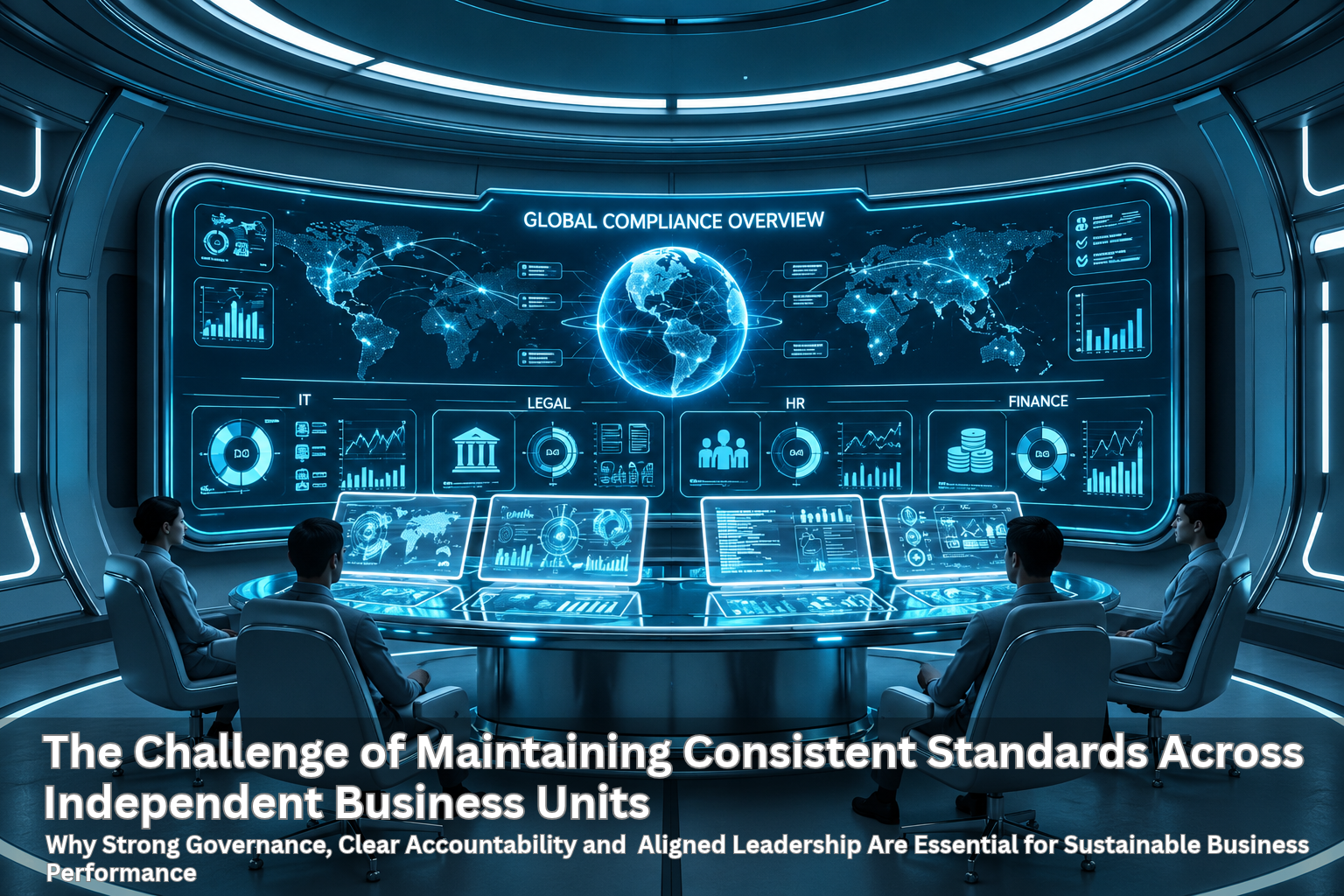
🎯 Why strong governance, clear accountability and aligned leadership are essential for sustainable business performance.
🌐 Introduction: Balancing Independence with Consistency
For organisations operating across multiple business units, maintaining consistent standards can be a significant management challenge. Each unit may have its own leadership team, operational priorities, working practices and commercial objectives. While this independence encourages innovation and faster decision-making, it can also create inconsistencies that affect overall business performance.
From customer service and operational efficiency to risk management and corporate governance, differences in standards can gradually undermine the wider organisation. Without a clear framework for alignment, business units may begin operating independently rather than contributing to a shared strategic vision.
The challenge is not to eliminate independence but to establish the right balance between local flexibility and group-wide consistency.
🔍 Why Consistent Standards Matter
Consistent standards provide a foundation for effective management, reliable performance and long-term growth. They ensure that business units understand the organisation’s expectations and work towards common objectives.
Organisations with clear standards can benefit from:
- ⚙️ Improved efficiency: Shared processes reduce duplication, errors and unnecessary costs.
- 🛡️ Stronger governance: Consistent policies improve oversight, accountability and risk management.
- 🤝 Better customer experiences: Customers receive reliable service across different divisions and markets.
- 📊 Reliable performance measurement: Common reporting frameworks allow meaningful comparisons.
- 🌱 Stronger organisational culture: Shared values encourage collaboration and collective responsibility.
Without these foundations, inconsistencies can become embedded in everyday operations, making them increasingly difficult to identify and resolve.
⚖️ 1. Understanding the Causes of Inconsistency
Differences between business units often develop gradually. Local leaders introduce processes that suit their circumstances, teams establish their own working practices, and operational decisions are made without considering their wider organisational impact.
Common causes include:
- 🔹 Different interpretations of corporate policies.
- 🔹 Limited communication between leadership teams.
- 🔹 Uneven investment in technology and employee development.
- 🔹 Conflicting performance measures and commercial priorities.
- 🔹 Insufficient monitoring of operational standards.
Addressing these challenges requires leaders to understand why inconsistencies occur and determine which differences are necessary and which create unnecessary risks.
👥 2. Balancing Local Autonomy with Group-Wide Expectations
Independent business units need sufficient freedom to respond to their markets, customers and operational requirements. Excessive central control can slow decision-making, restrict innovation and reduce the effectiveness of local leadership.
However, too much autonomy can lead to fragmented processes, inconsistent service delivery and conflicting organisational priorities.
The solution is to distinguish between standards that must remain consistent and areas where flexibility is beneficial.
For example, financial controls, ethical conduct, health and safety, data protection and regulatory compliance may require group-wide requirements. Meanwhile, local marketing activities and certain customer engagement strategies may reasonably differ.
✅ Senior leaders should clearly define mandatory standards, permitted variations and the process for approving exceptions.
This approach protects essential controls without restricting the independence that makes individual business units effective.
📊 3. Establishing Meaningful Performance Measures
Maintaining consistency becomes difficult when business units measure success differently. One division may prioritise revenue growth, while another focuses on cost reduction or operational output.
Although these priorities may be appropriate individually, different measurement systems can make it difficult for senior leaders to assess overall performance objectively.
A shared framework of key performance indicators (KPIs) can help address this challenge. Relevant measures may include:
- 💰 Profitability and financial performance.
- ⚙️ Productivity and operational efficiency.
- ⭐ Customer satisfaction and service quality.
- 🛡️ Compliance and risk management.
- 👨💼 Employee engagement and development.
Additional KPIs can reflect the specific responsibilities of each unit.
The objective is not to make every division identical. Instead, organisations should establish common principles for measuring performance and reporting results.
Regular reviews help leadership teams identify gaps, understand their causes and share effective practices across the organisation.
🛡️ 4. Strengthening Governance and Accountability
Clear governance is essential when responsibility is distributed across multiple leadership teams. Without defined accountability, business units may assume that certain responsibilities belong to central management, creating gaps in oversight and delaying corrective action.
An effective governance framework should include:
- 📌 Clear ownership of group-wide standards.
- 👔 Defined responsibilities for business unit leaders.
- 🔄 Consistent approval and escalation procedures.
- 📋 Regular compliance and performance reviews.
- 🚨 Transparent reporting of risks and corrective actions.
Governance should provide assurance without creating unnecessary bureaucracy. Reporting requirements must be proportionate to the organisation’s size, complexity and risk exposure.
Most importantly, business unit leaders must recognise that maintaining agreed standards is part of their responsibility for wider organisational performance.
💬 5. Improving Communication and Leadership Alignment
Policies and performance frameworks cannot guarantee consistency unless they are communicated clearly and implemented effectively.
When senior leaders provide conflicting messages, business units may develop different interpretations of organisational priorities. Over time, this can weaken trust and reduce cooperation between divisions.
Organisations can improve alignment through regular leadership meetings, cross-functional discussions and structured performance reviews.
💡 Leaders should encourage teams to share knowledge, discuss challenges and identify successful practices that could benefit other business units.
Employees must also understand how standards apply to their roles and where to seek guidance when requirements are unclear.
Consistent communication, supported by visible leadership commitment, helps turn corporate expectations into everyday working practices.
💻 6. Using Technology to Support Consistency
Disconnected systems, inconsistent reporting formats and duplicated administrative processes can make it difficult to monitor performance and identify emerging risks.
Technology can support more consistent operations by improving access to reliable information and simplifying reporting.
Organisations should consider aligning core systems for:
- 📈 Performance dashboards and management reporting.
- 💰 Financial planning and budgeting.
- 🔐 Risk and compliance monitoring.
- 📚 Employee training and policy documentation.
- ✅ Quality assurance and operational reviews.
However, standardisation should focus on areas where shared systems create measurable value. Local differences may still require tailored solutions.
The priority is to ensure that information is reliable, comparable and accessible to those responsible for decision-making.
🚀 7. Creating a Culture of Continuous Improvement
Consistent standards should not prevent innovation. As markets evolve and customer expectations change, organisations must regularly review their existing practices.
A culture of continuous improvement encourages business units to identify weaknesses, share learning and challenge inefficient processes constructively.
🔄 When a team discovers a more effective approach, leaders should assess whether it can be adopted elsewhere. Similarly, recurring deviations should be investigated to determine whether they reflect poor compliance, unclear policies or legitimate operational differences.
This approach allows organisations to strengthen standards while remaining adaptable and commercially competitive.