Leadership Challenges During International Acquisitions 🌍🤝
Leadership Challenges During International Acquisitions 🌍🤝
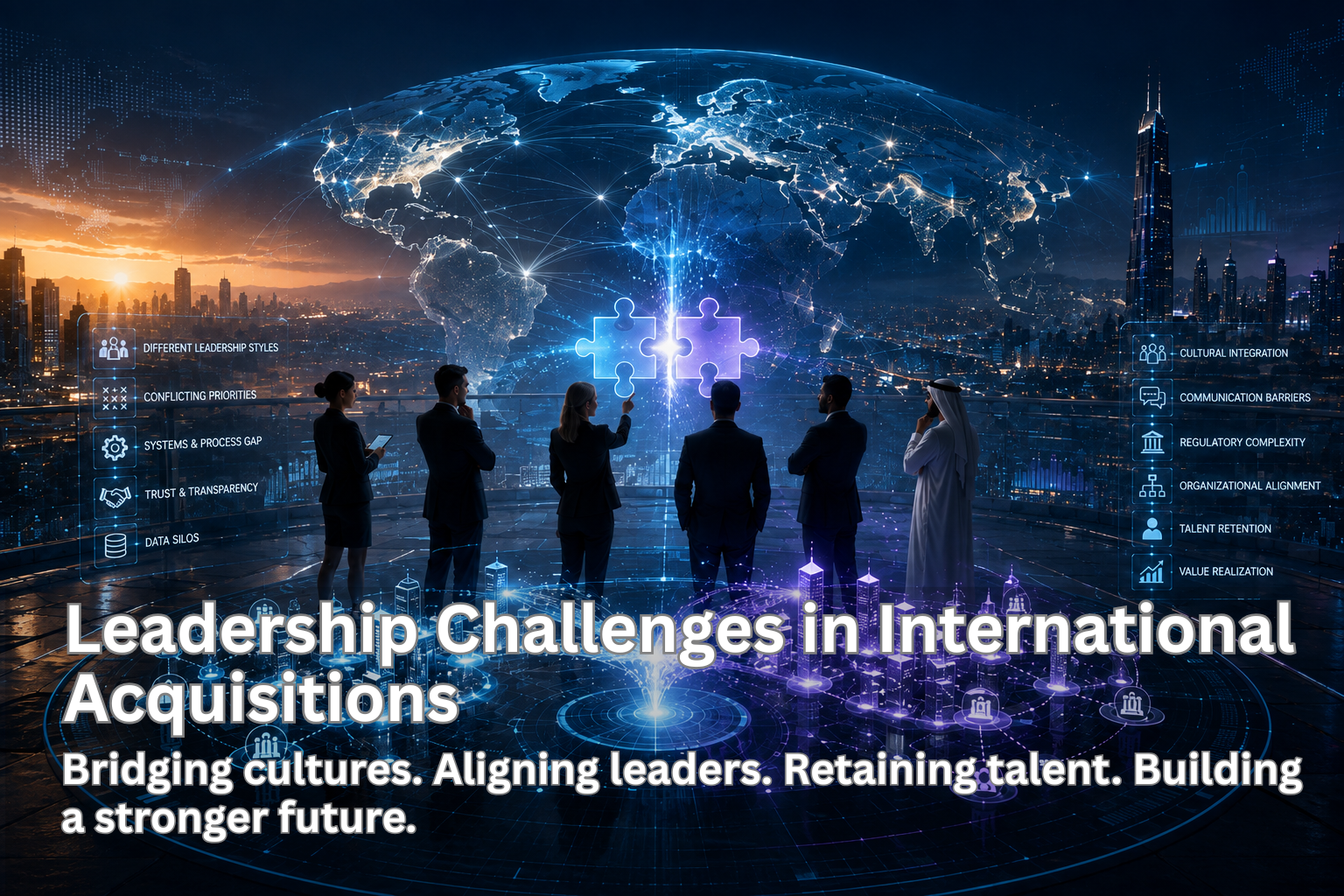
International acquisitions create opportunities for growth, market expansion, innovation, and long-term value. But successful integration requires more than financial investment and operational planning, it requires strong leadership.
Different cultures, leadership styles, business practices, and employee expectations can create significant challenges. The right leaders can bring people together, maintain business performance, and create a clear path towards successful integration.
💡 What Makes International Acquisitions Challenging?
An international acquisition often brings together organisations with different:
🌍
Cultures and values
👥 Leadership styles
💬 Communication approaches
🎯
Strategic priorities
⚙️ Ways of working
🏢
Organisational structures
Without effective leadership, these differences can create uncertainty, resistance, and disengagement.
🌍 1. Managing Cultural Differences
Cultural integration is one of the biggest challenges in international acquisitions.
Leaders must understand differences in decision-making, communication, hierarchy, risk, and collaboration, rather than assuming one approach will work everywhere.
Successful leaders focus on:
🤝 Building mutual understanding
👂 Listening to local perspectives
💬 Encouraging open communication
🎯 Establishing shared values
❤️ Creating an inclusive
environment
Integration takes time. Trust cannot be imposed; it must be built.
🎯 2. Aligning Leadership Teams
Bringing two leadership teams together can create competing priorities and different views on strategy, investment, organisational structure, and talent.
A successful integration requires a shared vision, clear accountability, and strong collaboration.
The objective is not simply to combine leadership teams, but to create one cohesive team capable of leading the organisation forward.
👥 3. Retaining Critical Talent
Acquisitions often create uncertainty around roles, reporting lines, career opportunities, and job security.
This can put critical talent at risk of leaving.
Leaders should identify key individuals early, communicate openly, recognise high performers, and provide clarity around future opportunities.
Talent retention is a strategic leadership priority, not simply an HR responsibility.
💬 4. Communicating Through Uncertainty
Employees want to understand what is changing, why it is changing, and what the future holds.
When communication is unclear, speculation can quickly replace confidence.
Effective leaders communicate consistently and transparently. They acknowledge what is known, explain what is still being decided, and listen to employee concerns.
Good communication is not about having every answer. It is about building trust throughout the process.
🔄 5. Leading Organisational Change
Integration may involve restructuring teams, consolidating systems, and changing established ways of working.
Strong change leadership combines:
🎯 A clear vision
💬 Consistent communication
🤝 Employee
involvement
📈 Accountability
👂 Active listening
🌱 Leadership
development
The goal should be commitment to change, not simply compliance with it.
🧭 6. Balancing Global Strategy with Local Expertise
International organisations must balance global consistency with local knowledge.
Local teams understand their customers, markets, regulations, and cultural environment. Effective leaders recognise this expertise while maintaining clear global objectives.
The strongest integrations combine:
🌍 Global strategic direction
🏢 Local market expertise
🤝 Shared
leadership principles
💡 Local innovation
Integration does not have to mean uniformity.
🌟 The Leadership Qualities That Matter
International acquisitions require leaders who can operate confidently across complex environments.
Key qualities include:
🌍 Cross-cultural awareness
❤️ Emotional intelligence
💬 Strong communication
🤝 Collaboration
🎯
Strategic thinking
🔄 Adaptability
👂 Active listening
📈 Commercial judgement
🧭 Vision and clarity
💼 Integrity and accountability
The strongest leaders can protect short-term performance while keeping sight of long-term value creation.
📊 Why Leadership Matters
Effective leadership can help organisations achieve:
✅ Stronger employee engagement
✅ Greater talent retention
✅ Faster
cultural integration
✅ Better leadership alignment
✅ More effective decision-making
✅ Reduced disruption
✅ Stronger stakeholder confidence
✅ Sustainable long-term value
Ultimately, an acquisition succeeds when people understand the strategy, trust the leadership, and see their role in the future organisation.
🏢 The Role of Boards and Executive Teams
Boards and executive teams must look beyond the transaction itself and consider the leadership capability required for successful integration.
Key questions include:
🔎 Do we have the right leadership
capabilities?
🌍 Can our leaders operate effectively across
cultures?
👥 Which leaders and capabilities are critical to retain?
🎯 Is integration accountability clearly defined?
💬 Are employees receiving consistent communication?
🔄 Can
leaders manage change while maintaining performance?
Identifying these requirements early can reduce disruption and improve the likelihood of achieving the acquisition's strategic objectives.
🔮 Looking Ahead
International acquisitions will remain an important driver of global growth. But technology, capital, and strategy alone do not create sustainable value.
People do.
The leaders who succeed will be those who can bridge cultures, align teams, retain critical talent, communicate with clarity, and lead confidently through uncertainty.
An acquisition is more than combining two businesses. It is about bringing people together around a shared future. 🌍
🤝 How Wyman Bain Can Help
At Wyman Bain, we understand that leadership is central to successful organisational transformation and international growth.
We help organisations identify, assess, and appoint exceptional leaders who can navigate complexity, build high-performing teams, and deliver sustainable results.
Because the right leadership can turn an acquisition from a completed transaction into long-term value.
Preparing for an international acquisition or navigating post-acquisition integration? Wyman Bain can help you identify the leadership capability needed for success.
Empowering exceptional leaders. Building stronger organisations. Shaping the future. 🌍✨