Why Operational Dependencies Should Be Identified Before They Become Disruptions 🔗⚠️
Why Operational Dependencies Should Be Identified Before They Become Disruptions 🔗⚠️
In today’s fast-moving business environment, organisations rely on increasingly complex networks of people, processes, technology, suppliers and systems. While these connections help businesses operate efficiently, they can also create hidden dependencies that become critical points of failure when something goes wrong.
The challenge is not simply responding to disruption. It is knowing where disruption is most likely to begin, before it happens.
🔍 What Are Operational Dependencies?
An operational dependency exists when one part of a business relies on another to function effectively.
This could be a technology platform supporting a critical business process, a specialist employee holding essential knowledge, a supplier providing a key service, or another internal team responsible for completing an important operational step.
For example:
- A finance team depends on a particular software platform to process payments.
- A manufacturing operation relies on a single supplier for a critical component.
- A project depends on one specialist employee with unique technical knowledge.
- A customer service function relies on another team to resolve technical issues.
- A business process depends on several systems working together seamlessly.
Individually, these dependencies may appear manageable. Collectively, however, they can create significant operational risk.
⚠️ Why Hidden Dependencies Become Disruptions
The biggest risk often comes from dependencies that have never been properly identified, documented or assessed.
When everything is working normally, a dependency may remain invisible. But when a system fails, a key employee leaves, a supplier experiences difficulties or priorities suddenly change, the dependency can become an immediate operational bottleneck.
A relatively small failure can therefore trigger a much larger chain reaction.
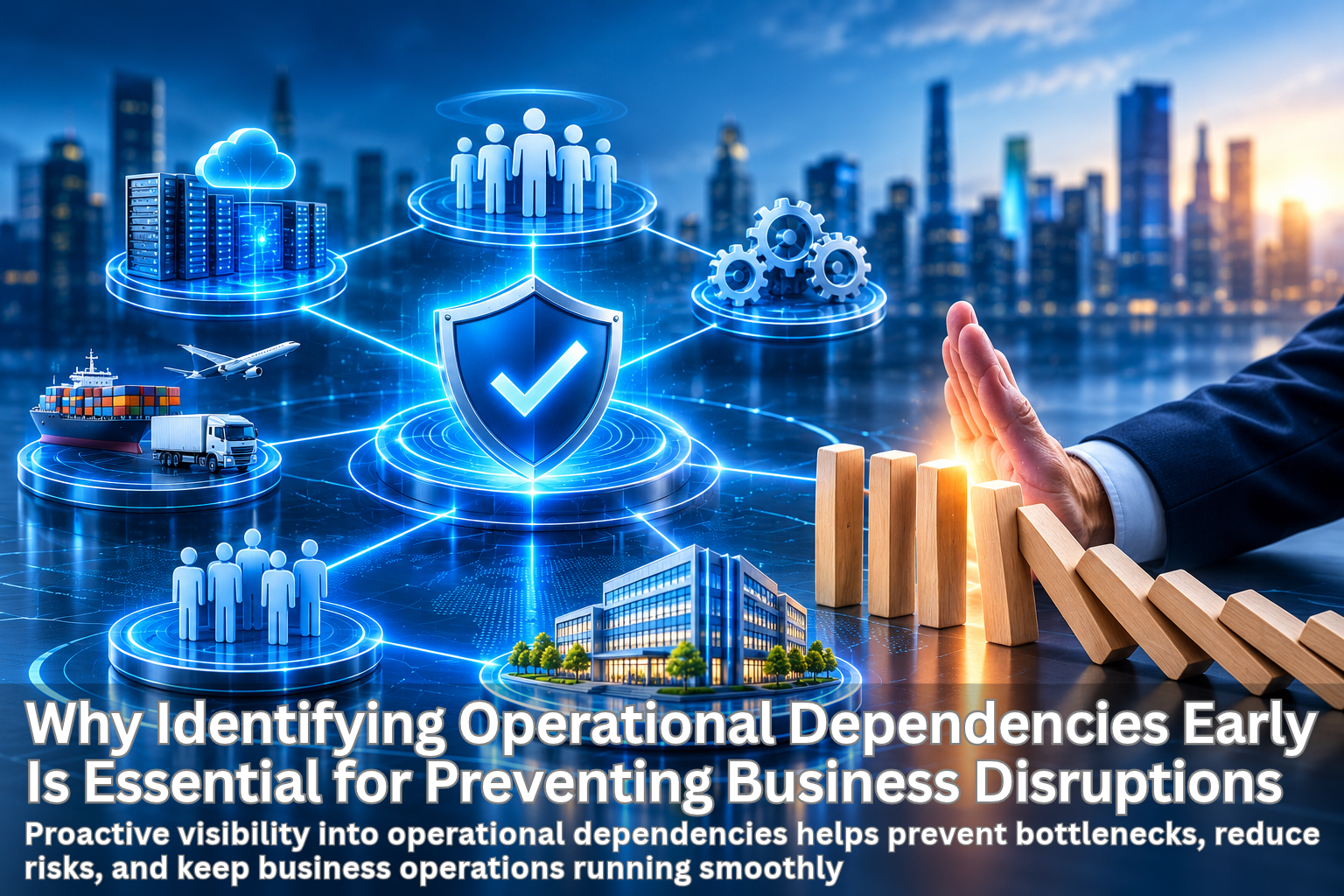
One disruption can lead to another, and another, creating a domino effect across the organisation. 🔄
This is why businesses should move beyond simply asking:
“What could go wrong?”
They should also ask:
“What does this process rely on, and what happens if that dependency becomes unavailable?”
🧭 Mapping Dependencies Before Problems Occur
Effective dependency management starts with visibility.
Businesses should identify the critical relationships between:
People → Processes → Technology → Suppliers → Customers
Mapping these relationships helps organisations understand which areas are essential to business continuity and where a single point of failure may exist.
A dependency map can also highlight areas where there is:
- Limited backup or redundancy
- Over-reliance on a single supplier
- Critical knowledge held by one individual
- Outdated or poorly documented processes
- Systems that rely heavily on other platforms
- Limited recovery options
- Unclear ownership or accountability
Once these dependencies are visible, they can be assessed and managed rather than discovered during a crisis.
👥 People Are Often the Most Overlooked Dependency
Technology and suppliers are usually considered when organisations assess operational risk, but people can be equally critical.
A business may unknowingly depend on one individual who understands a complex process, manages an important relationship or has specialist knowledge that is not documented elsewhere.
If that person leaves unexpectedly or becomes unavailable, the organisation may discover that replacing the role is not enough, it also needs to replace the knowledge.
Cross-training, succession planning, knowledge sharing and clear documentation can significantly reduce this risk. 🧠
🛠️ Turning Dependency Awareness Into Resilience
Identifying dependencies is only the first step. The real value comes from taking action.
Organisations can strengthen resilience by:
1. Prioritising Critical Dependencies 🎯
Not every dependency carries the same level of risk. Focus first on those that could significantly affect customers, revenue, compliance, safety or business continuity.
2. Establishing Alternatives 🔄
Where possible, identify alternative suppliers, systems, processes or people who can provide continuity if the primary option becomes unavailable.
3. Documenting Critical Knowledge 📚
Important processes and specialist knowledge should not exist solely in someone's head. Clear documentation makes it easier for others to step in when required.
4. Testing Business Continuity Plans 🧪
A plan that has never been tested may not work as expected. Scenario testing can reveal weaknesses before a real disruption exposes them.
5. Reviewing Dependencies Regularly 🔍
Operational dependencies change as businesses grow, restructure, introduce new technology and work with new suppliers. Dependency mapping should therefore be an ongoing activity rather than a one-off exercise.
🚀 From Reactive Response to Proactive Resilience
The strongest organisations do not wait for disruption before examining their operational weaknesses.
They continually ask where their critical dependencies exist, how those dependencies could fail and what would happen next.
This creates a shift from reactive problem-solving to proactive resilience.
Instead of discovering a weakness during a crisis, businesses can identify it while there is still time to address it.
💡 The Strategic Advantage
Understanding operational dependencies is not simply about risk reduction. It can also support better decision-making.
When leaders understand how people, processes, technology and suppliers connect, they can make more informed decisions about investment, resource allocation, outsourcing, technology adoption and organisational structure.
Ultimately, resilience comes from understanding how the business actually works — not just how it is supposed to work on paper.
Operational disruption rarely occurs in isolation. More often, it exposes connections and dependencies that were already present but had not been fully understood.
By identifying these dependencies before they become critical, organisations can reduce single points of failure, strengthen continuity and respond more effectively when circumstances change.
The goal is not to eliminate every dependency that would be unrealistic. The goal is to understand them, manage them and prepare for what happens when they are tested. 🔗💼
At
Wyman Bain, we recognise that
sustainable business performance depends on more than individual functions working well. It depends on the
people, expertise, leadership and processes connecting those functions together.
CONTACT US >>>>>>