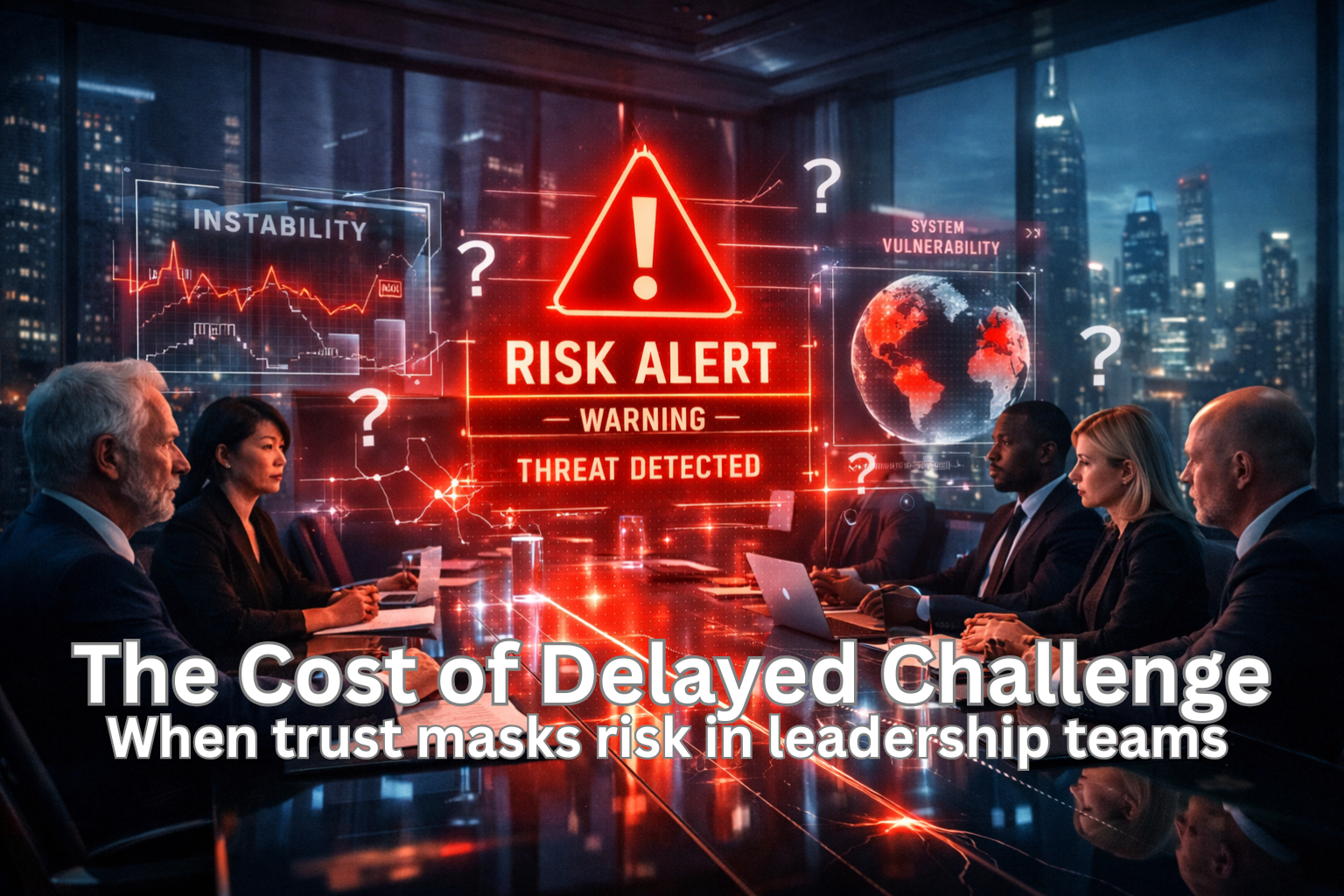
The Cost of Delayed Challenge in High-Trust Leadership Teams ⚖️🧠
The Cost of Delayed Challenge in High-Trust Leadership Teams ⚖️🧠
High-trust leadership teams are often seen as the
ideal.
Strong relationships. Psychological safety. Alignment built over time. 🤝
Yet many of the most damaging strategic failures do not occur in low-trust environments.
They occur in teams where trust is high and
challenge is delayed.
Delayed challenge is rarely deliberate.
It emerges quietly, shaped by respect for colleagues, confidence in collective judgement, or a desire to maintain momentum.
Over time, however, its cost can be substantial.
When Trust Softens Tension 🧠
Trust is foundational to effective
leadership.
It enables openness, speed and resilience under pressure.
But in high-trust teams, familiarity can gradually soften tension.
Questions are phrased more gently.
Assumptions go untested.
Dissent is deferred, not because leaders disagree, but because they assume alignment or choose not to interrupt progress.
What begins as cohesion can become constraint.
The Drift from Challenge to Comfort ⚠️
Delayed challenge rarely looks like inaction.
More often, it appears as agreement that arrives too easily.
Common signals include:
- Decisions reached quickly, with limited interrogation
- Risks acknowledged but not examined in depth
- Confidence in experience replacing curiosity about alternatives
- Difficult questions postponed until “later”, which rarely arrives
By the time challenge surfaces, strategic flexibility may already be lost.
Why Timing Matters ⏳
Challenge is most valuable early, when assumptions remain flexible and options are still open.
When it is delayed, leadership teams often find themselves debating execution rather than direction, or defending decisions rather than testing them.
The issue is not capability or intent.
It is the erosion of strategic optionality.
High-trust teams can confuse cohesion with clarity, and alignment with rigour.
The Discipline High-Performing Teams Maintain 🎯
The strongest leadership teams do not rely on trust alone.
They pair trust with discipline.
This means:
- Treating challenge as a leadership responsibility, not a disruption
- Stress-testing assumptions early, not retrospectively
- Separating respect for individuals from scrutiny of ideas
- Creating space for dissent before decisions harden
Trust should reduce the personal risk of challenge, not eliminate the need for it.
Designing Productive Tension Without Undermining Trust 🔄
High-performing teams intentionally design for constructive tension.
They:
- Normalise questioning, especially when performance is strong
- Invite minority and divergent views before consensus forms
- Ask what would have to be true for a decision to be wrong
- Revisit foundational assumptions as conditions evolve
In doing so, they protect both trust and strategic judgement.
High trust is a powerful asset, but it is not a substitute for challenge.
When challenge is delayed, teams may move faster in the short term, but at the cost of adaptability and resilience over time.
The most effective leadership teams understand this balance.
They preserve trust and they preserve tension.
Because sustained performance depends on both.
CONTACT US >>>>>>>>>>