🌍 Executive Talent Strategies for Circular Economy Models ♻️
🌍 Executive Talent Strategies for Circular Economy Models ♻️
The circular
economy has moved beyond sustainability rhetoric.
It is now a strategic growth agenda.
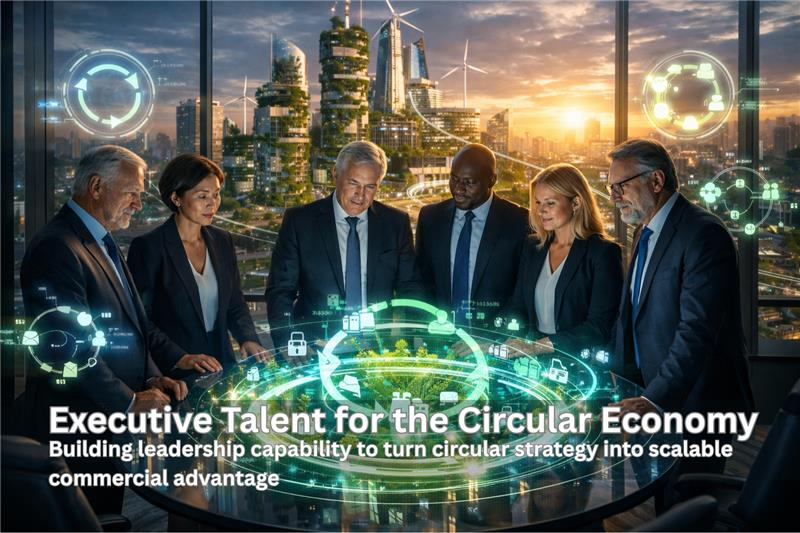
For organisations transitioning from linear “take–make–waste” models to regenerative systems, the greatest risk is not technical feasibility, it is leadership capability.
At
Wyman Bain, we advise boards and executive teams on building the talent foundations required to make circular models commercially viable, operationally scalable and culturally embedded.
🔄 Circular Economy Is a
Business Model Shift
Circularity reshapes how value is created, captured and sustained.
It requires organisations to:
- Design products for durability, reuse and recovery
- Reconfigure supply chains around regeneration and traceability
- Shift revenue models towards service, access and lifecycle value
- Align performance metrics with long-term resource efficiency
This is enterprise transformation, not a sustainability programme.
And enterprise transformation demands
executive reinvention.
🧭 The Executive
Capability Imperative
Many organisations have sustainability expertise.
Few have executive teams equipped to lead circular business models at scale.
Critical capability gaps often include:
1️Systems Thinking at Board Level
Circular value chains span suppliers, partners, regulators and customers. Leaders must manage interdependencies, not isolated functions.
2️Commercial Innovation Discipline 💡
Circular models frequently require experimentation, subscription services, remanufacturing, product-as-a-service. Executives must balance innovation with financial rigour.
3️Operational Re-Architecture ⚙️
Reverse logistics, material transparency and lifecycle accountability demand a step-change in operational design.
4️Ecosystem Governance and Partnership Leadership 🤝
Circular economies are collaborative by design. Executives must lead across ecosystems, not simply within organisational boundaries.
📊 Aligning
Talent Strategy with Circular Ambition
Circular transformation stalls when incentives remain linear.
High-performing organisations:
- Redefine executive competencies to include sustainability literacy and systems leadership
- Embed circular KPIs into performance frameworks and remuneration
- Strengthen succession planning around regenerative innovation capability
- Attract cross-sector talent with ecosystem and platform experience
- Integrate sustainability into core commercial decision-making
Talent strategy must evolve alongside business strategy.
🏗️
Questions for the Board
Boards should challenge:
- Do we understand circular economics as deeply as traditional P&L dynamics?
- Are incentives aligned with long-term regenerative value?
- Do we have leaders capable of orchestrating ecosystem partnerships?
- Is circularity embedded in enterprise governance, or confined to a function?
Circular ambition without
executive alignment results in isolated pilots, not scaled impact.
🚀 From Compliance to Competitive Advantage
Organisations that treat circularity as compliance will limit its potential.
Those that treat it as a growth and resilience strategy will differentiate.
The differentiator is leadership.
At Wyman Bain, we support organisations to:
- Assess executive readiness for circular transformation
- Redesign governance for regenerative operating models
- Align incentives with sustainable value creation
- Build leadership pipelines for long-term resilience
The circular economy is not simply an environmental commitment.
It is a leadership and commercial opportunity.
And its success depends on executive talent aligned to long-term, systemic value.
If your organisation is pursuing circular transformation, the critical question is not whether your strategy is ambitious, but whether your leadership capability is equipped to deliver it. 🌍♻️