
The Boardroom Warning Signs of Organisational Complacency ⚠️🏛️
The Boardroom Warning Signs of Organisational Complacency ⚠️🏛️
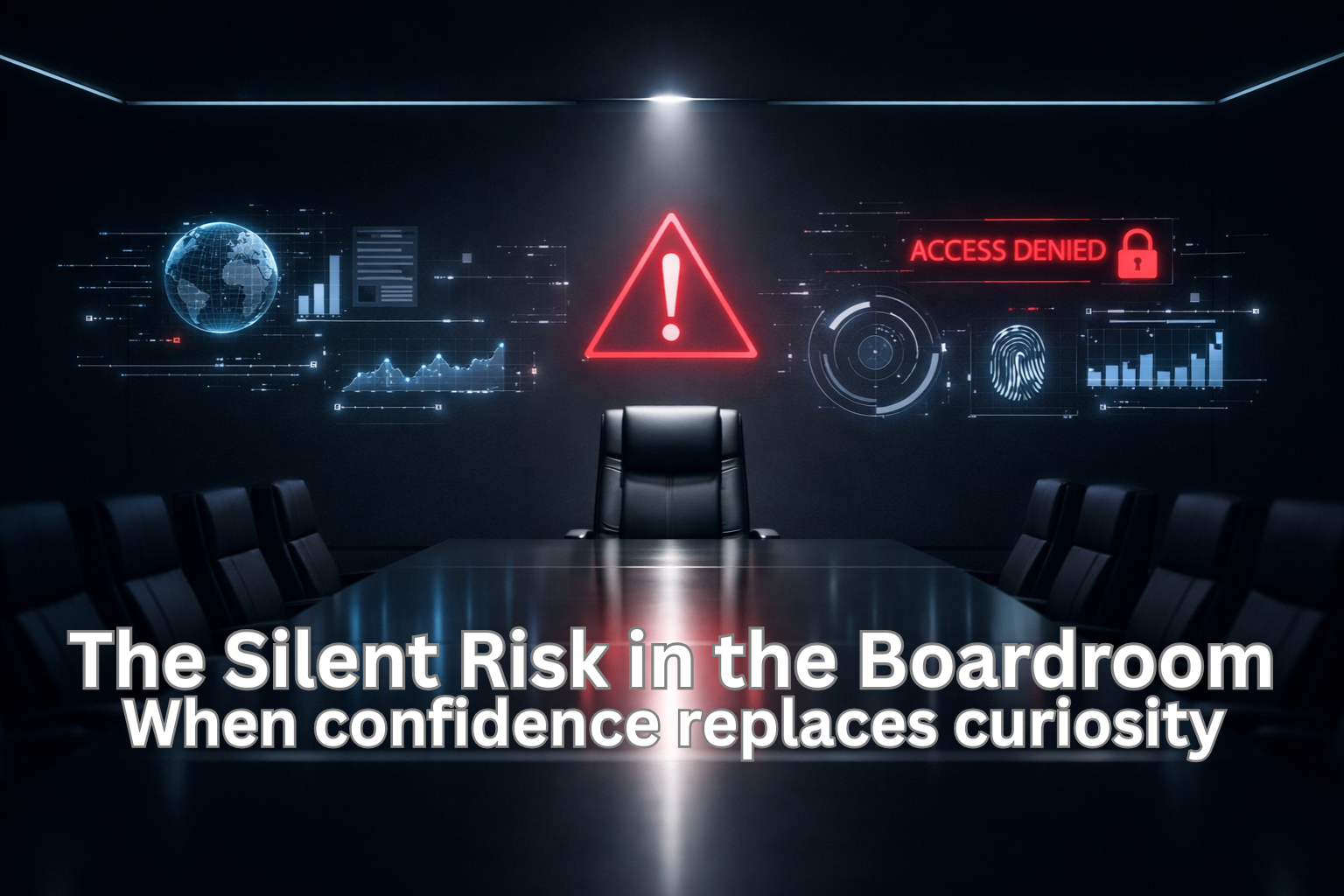
Organisational complacency rarely announces itself.
It doesn’t arrive as failure or crisis. More often, it settles quietly into the boardroom, disguised as confidence, stability and past success.
By the time complacency becomes visible, strategic options have already narrowed.
For boards, the challenge is not eliminating
risk, but recognising when comfort has begun to replace curiosity and reassurance has edged out rigour.
1. Strong
Results Shut Down, Rather Than Deepen, Debate 📊
Sustained performance can dull strategic edge.
Complacency emerges when strong results are treated as evidence that the strategy no longer requires interrogation.
This shows up when:
- Strategy discussions shorten because “the numbers are solid”
- Challenge is subtly discouraged as unnecessary or disruptive
- External shifts are acknowledged, but not explored in depth
Good performance should prompt better questions, not fewer.
2.
Strategy Becomes a Story, Not a System 📖
Clear narratives matter. But when boardroom attention shifts from how the strategy works to how it sounds, thinking weakens.
Warning signs include:
- More time spent refining messaging than stress-testing assumptions
- Risks reframed to fit the narrative rather than examined on their own terms
- Ambiguity smoothed over instead of explored
When the story leads and the thinking follows, organisations can appear confident while becoming strategically fragile.
3. Consensus Comes Too Easily 🤝
Effective boards disagree productively.
Complacency sets in when alignment arrives quickly, not because the issues are simple, but because discomfort is avoided.
This often looks like:
- Repeated agreement without substantive debate
- Experienced directors choosing silence to “keep momentum”
- Dissent reframed as negativity rather than governance
Easy consensus is rarely a sign of clarity.
More often, it signals unexamined assumptions.
4. External Signals Are Acknowledged but Not Acted On 🌍
Markets, customers, competitors and regulators change long before financial performance does.
Complacent boards tend to:
- Note disruption without adjusting strategic choices
- Discount weak signals because impact is not yet visible
- Assume the organisation will have time to respond later
By the time change is undeniable, optionality is often gone.
5. The Strategy Changes in
Language, Not Logic 🔄
Another warning sign is strategic stability that is cosmetic rather than considered.
If the strategy appears to “evolve” mainly through refreshed terminology, new slides or revised ambition statements, while underlying assumptions remain untouched, complacency may be present.
True strategic thinking revisits fundamentals, not just presentation.
6.
Confidence Outpaces Curiosity 🧠
Confidence is essential in the boardroom.
Curiosity is indispensable.
Complacency emerges when boards:
- Stop asking what could invalidate the strategy
- Confuse conviction with certainty
- Treat doubt as weakness rather than discipline
The strongest boards remain intellectually restless, especially when performance is strong.
The
Role of the Board and Chair 🪑
Preventing complacency is not about creating anxiety or indecision.
It is about protecting the organisation’s capacity for clear, independent judgement.
Effective boards and Chairs:
- Create space for dissent and inconvenient data
- Ask what would have to be true for the strategy to fail
- Distinguish confidence in direction from certainty of outcome
- Allow the strategic narrative to evolve as understanding changes
Strong governance does not demand certainty.
It preserves strategic judgement under pressure.
Final Thought 💭
Organisational complacency is rarely a failure of intelligence or intent.
It is a failure of sustained strategic attention.
Boards that remain curious, challenging and willing to sit with uncertainty give their organisations the best chance of navigating what comes next, not simply defending what has already worked.
CONTACT US >>>>>>>>