Why Business Growth Often Outpaces Leadership Capability 🚀
Why Business Growth Often Outpaces Leadership Capability 🚀
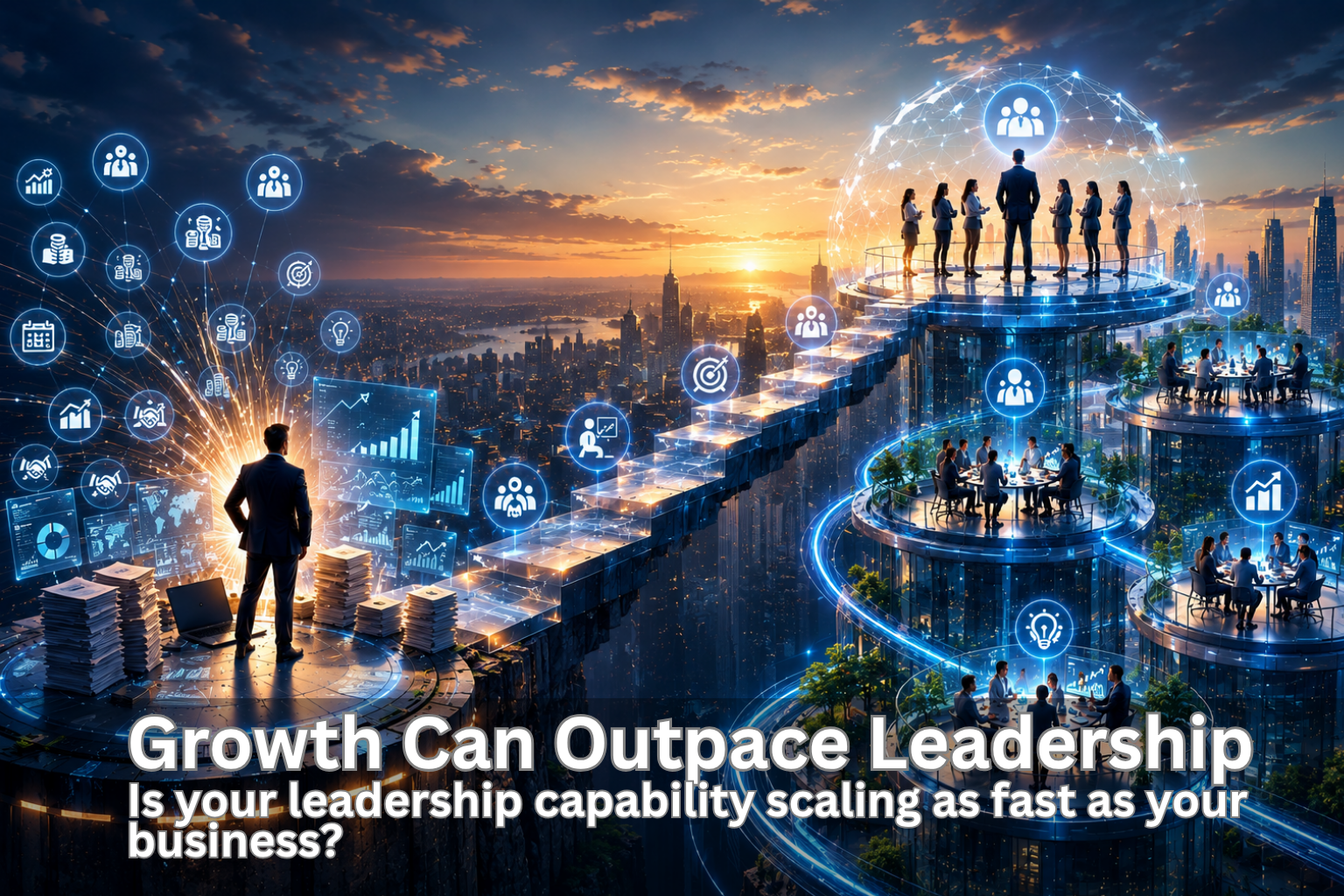
Business growth is exciting. 📈 New clients, bigger teams, increased revenue and ambitious opportunities are all positive signs that an organisation is moving forward.
But there is a challenge that many growing businesses discover too late:
The business can grow faster than its leadership capability.
What worked when a company had 10 employees may not work when it has 50, 100 or more. As organisations become larger and more complex, leaders need to evolve alongside them.
🚀 When growth changes the leadership equation
In the early stages of a business, leaders are often directly involved in almost everything. They make decisions quickly, solve problems personally and maintain close relationships with employees and customers.
This hands-on approach can be a major advantage when the organisation is small.
However, as growth accelerates, the same approach can become a limitation. There are more people, more decisions, more stakeholders and more competing priorities. Leaders simply cannot remain involved in everything.
At this point, organisations need leadership that can scale with the business.
📈 The skills that got you here may not get you there
One of the most important things growing businesses need to recognise is that leadership requirements change over time.
A leader may have been highly successful because they were:
- 💡 Entrepreneurial and commercially focused
- ⚡ Quick to make decisions
- 🤝 Strong at building relationships
- 🔥 Highly driven and hands-on
- 🏆 Excellent within their specialist area
But the next stage of growth may require them to become better at:
- 👥 Developing and empowering other leaders
- 🎯 Delegating effectively
- 🗣️ Communicating across a larger organisation
- 📊 Creating accountability
- 🌱 Coaching and developing talent
- 🔭 Thinking strategically rather than only operationally
This transition is not always easy. In fact, it can be one of the biggest challenges facing a growing organisation.
👤 Why technical expertise isn't always enough
A common mistake is assuming that the best performer in a particular role will automatically become the best leader of that function.
For example, the strongest salesperson may be promoted to Sales Director, or an exceptional technical specialist may become a senior manager.
Their expertise is valuable, but leadership requires a different set of capabilities.
Effective leaders need to influence, communicate, develop people, manage performance and create an environment where others can succeed. 🌱
Without the right development and support, talented individuals can find themselves struggling when they move into leadership positions.
⚠️ When leadership becomes the bottleneck
When leadership capability fails to keep pace with growth, the warning signs can appear across the business.
You may see:
- 🐌 Decisions taking longer
- 🔄 Too many issues being escalated to senior leaders
- ❓ Unclear ownership and accountability
- 😤 Frustrated employees and emerging leaders
- 📣 Communication becoming inconsistent
- 🔥 Senior leaders spending too much time firefighting
The problem may initially look like a process, performance or communication issue.
Often, however, the underlying challenge is leadership capacity.
The organisation has outgrown the leadership model that previously made it successful.
🌱 Building leadership capability before you need it
The most effective organisations do not wait until leadership gaps become obvious.
They think ahead.
Leadership teams should regularly consider:
- 🔍 What capabilities will we need for our next stage of growth?
- 👥 Do our current leaders have those capabilities?
- 🌱 Who are our future leaders?
- 🎯 Where are the biggest leadership gaps?
- 🔄 Are we preparing people for their next role?
- 🧭 Does our leadership structure support our strategic ambitions?
Developing leadership capability ahead of growth gives organisations a stronger foundation for managing change and complexity.
It also reduces the risk of relying too heavily on a small number of senior individuals.
🔄 Leaders need to evolve as the organisation evolves
Perhaps the biggest shift is moving from doing and deciding to enabling and developing others.
As organisations grow, leaders need to spend less time being the person with all the answers and more time creating the conditions for other people to succeed.
That means building trust, setting clear expectations, developing talent and giving people the confidence and authority to make decisions.
It is a significant transition, particularly for leaders whose personal drive and expertise helped build the organisation in the first place. 💪
💡 The question every growing business should ask
Instead of asking only:
"Are we ready to grow?"
Leaders should also ask:
"Are our leadership capabilities ready for the organisation we are becoming?" 🚀
The answer can reveal important gaps in leadership, succession, talent development and organisational structure.
At Wyman Bain, we understand that sustainable business growth requires more than a strong commercial strategy. It requires the leadership capability to turn that strategy into sustained performance.
By developing the right leadership capability at the right time, organisations can build stronger teams, navigate complexity and create the foundations for long-term success. 🌟
Your growth ambitions deserve leadership capability that can keep pace.