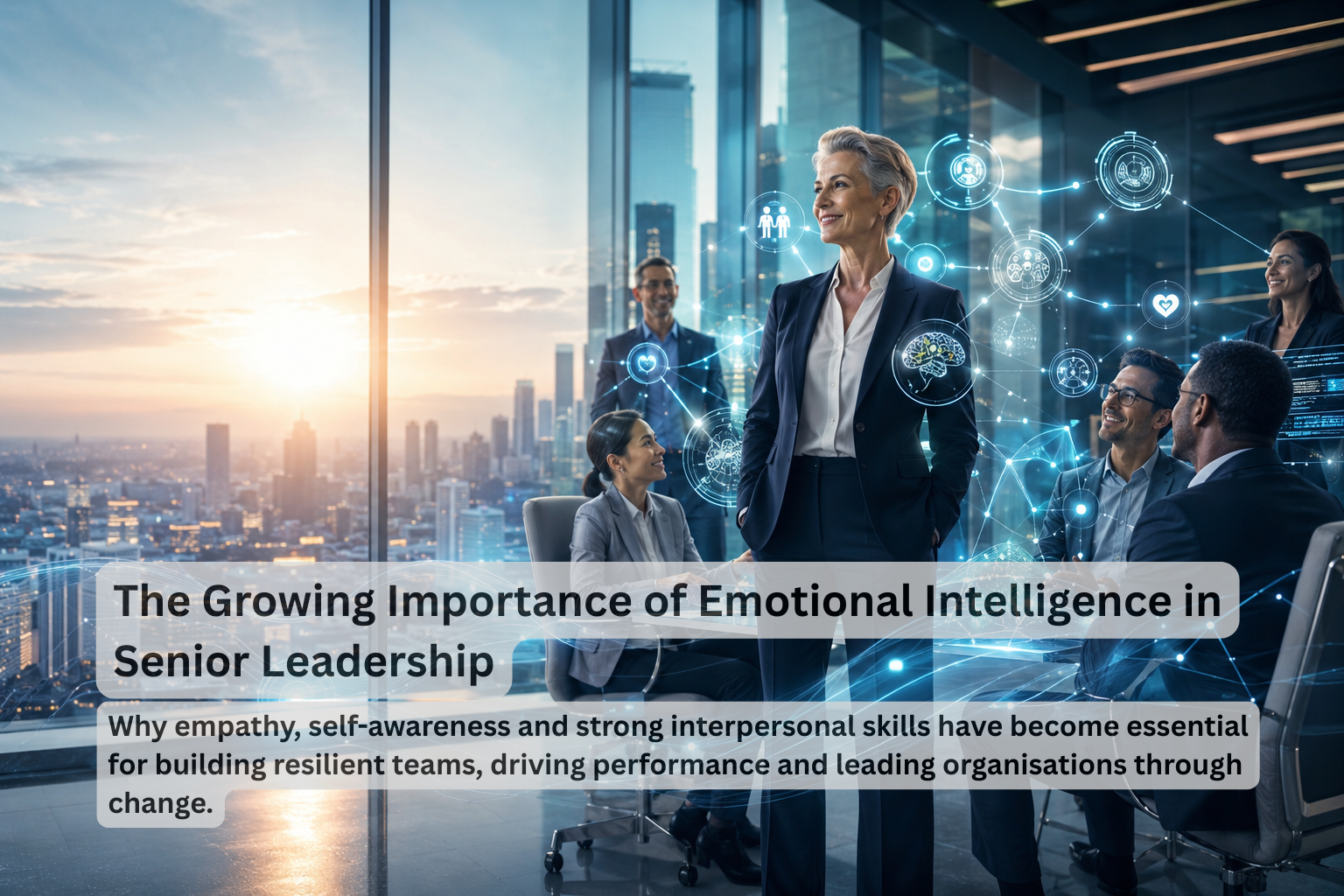
The Growing Importance of Emotional Intelligence in Senior Leadership
The Growing Importance of Emotional Intelligence in Senior Leadership
🧠 The Growing Importance of Emotional Intelligence in Senior Leadership
In today's rapidly evolving business landscape, technical expertise and strategic thinking alone are no longer enough to define exceptional leadership. Organisations are increasingly recognising that Emotional Intelligence (EI) has become one of the most valuable qualities a senior leader can possess. 🌍
From inspiring teams through uncertainty to building high-performing workplace cultures, emotionally intelligent leaders create environments where both people and businesses thrive.
💡 What is Emotional Intelligence?
Emotional Intelligence is the ability to recognise, understand and manage your own emotions while also recognising and influencing the emotions of others.
It is commonly built around five key competencies:
😊 Self-awareness
⚖️ Self-regulation
🚀 Motivation
🤝 Empathy
💬 Social skills
Together, these qualities enable leaders to communicate effectively, make balanced decisions and build stronger professional relationships.
📈 Why Emotional Intelligence Matters More Than Ever
Today's workplaces are more diverse, digitally connected and fast-paced than ever before. Employees expect authentic leadership, meaningful communication and genuine support from those leading their organisations.
Senior leaders with high emotional intelligence are better equipped to:
✅ Lead confidently through change and uncertainty.
✅ Build trust across teams and departments.
✅ Resolve conflict constructively before it escalates.
✅ Inspire engagement, collaboration and innovation.
✅ Improve employee wellbeing and retention.
Research consistently shows that organisations led by emotionally intelligent leaders experience stronger employee engagement, improved productivity and higher overall performance.
👥 Building Stronger Relationships
Leadership is fundamentally about people.
Whether engaging with employees, clients, investors or stakeholders, successful leaders understand that every interaction shapes trust and credibility.
Emotionally intelligent leaders:
• 👂 Listen actively before responding.
• ❤️ Demonstrate genuine empathy.
• 🤝 Build meaningful connections.
• 🌟 Encourage openness and psychological safety.
• 🙌 Recognise and celebrate the contributions of others.
These behaviours foster loyal, motivated teams that are more willing to collaborate and embrace change.
🚀 Better Decision-Making Under Pressure
Senior leadership often involves making difficult decisions with incomplete information.
Leaders with strong emotional intelligence remain calm under pressure, avoid impulsive reactions and consider both commercial outcomes and human impact before acting.
Rather than allowing stress or emotion to dictate decisions, they respond thoughtfully and confidently, earning respect from those around them.
🌱 Creating Positive Workplace Cultures
Culture starts at the top. Employees naturally mirror the behaviours demonstrated by senior leaders. Leaders who show respect, transparency, empathy and accountability create cultures where people feel valued and empowered.
Positive workplace cultures often result in:
• 💼 Higher employee engagement
• 📉 Reduced staff turnover
• 💡 Greater innovation
• 🤗 Stronger collaboration
• 🎯 Improved organisational performance
Emotional intelligence is therefore not simply a personal skill, it is a competitive business advantage.
🔄 Leading Through Change
Change has become a constant feature of modern business.
Whether navigating organisational transformation, economic uncertainty or technological disruption, emotionally intelligent leaders help people adapt with confidence.
They:
📢 Communicate openly and honestly.
🤲 Acknowledge concerns and uncertainty.
🎯 Provide clarity and reassurance.
🌍 Encourage resilience and adaptability.
🌟 Maintain focus on long-term goals.
Teams are far more likely to embrace change when they feel understood and supported.
📚 Can Emotional Intelligence Be Developed?
Absolutely.
Unlike IQ, emotional intelligence can be strengthened throughout a leader's career.
Practical ways to develop emotional intelligence include:
📖 Investing in executive coaching.
🧘 Practising self-reflection.
👂 Improving active listening skills.
🤝 Developing empathy through meaningful conversations.
🎓 Committing to continuous leadership development.
The most effective leaders understand that personal growth is an ongoing journey.
As organisations continue to navigate an increasingly complex and people-focused world, emotional intelligence has become a defining characteristic of outstanding senior leadership.
Leaders who combine strategic expertise with empathy, resilience and exceptional interpersonal skills are better equipped to inspire teams, strengthen organisational culture and deliver sustainable business success.
At Wyman Bain, we understand that exceptional leadership goes beyond qualifications and experience. We recognise the importance of emotional intelligence in identifying, developing and supporting leaders who can drive long-term organisational success while empowering the people around them.
Because great leadership isn't just about achieving results, it's about bringing people with you every step of the journey. 🌟