The Cost of Leadership Vacuums During Business Growth 🚀
The Cost of Leadership Vacuums During Business Growth 🚀
Business growth is exciting. New opportunities emerge, teams expand, revenues increase and ambitious plans start becoming reality. 📈
But growth also brings new challenges and one of the most overlooked is leadership capacity.
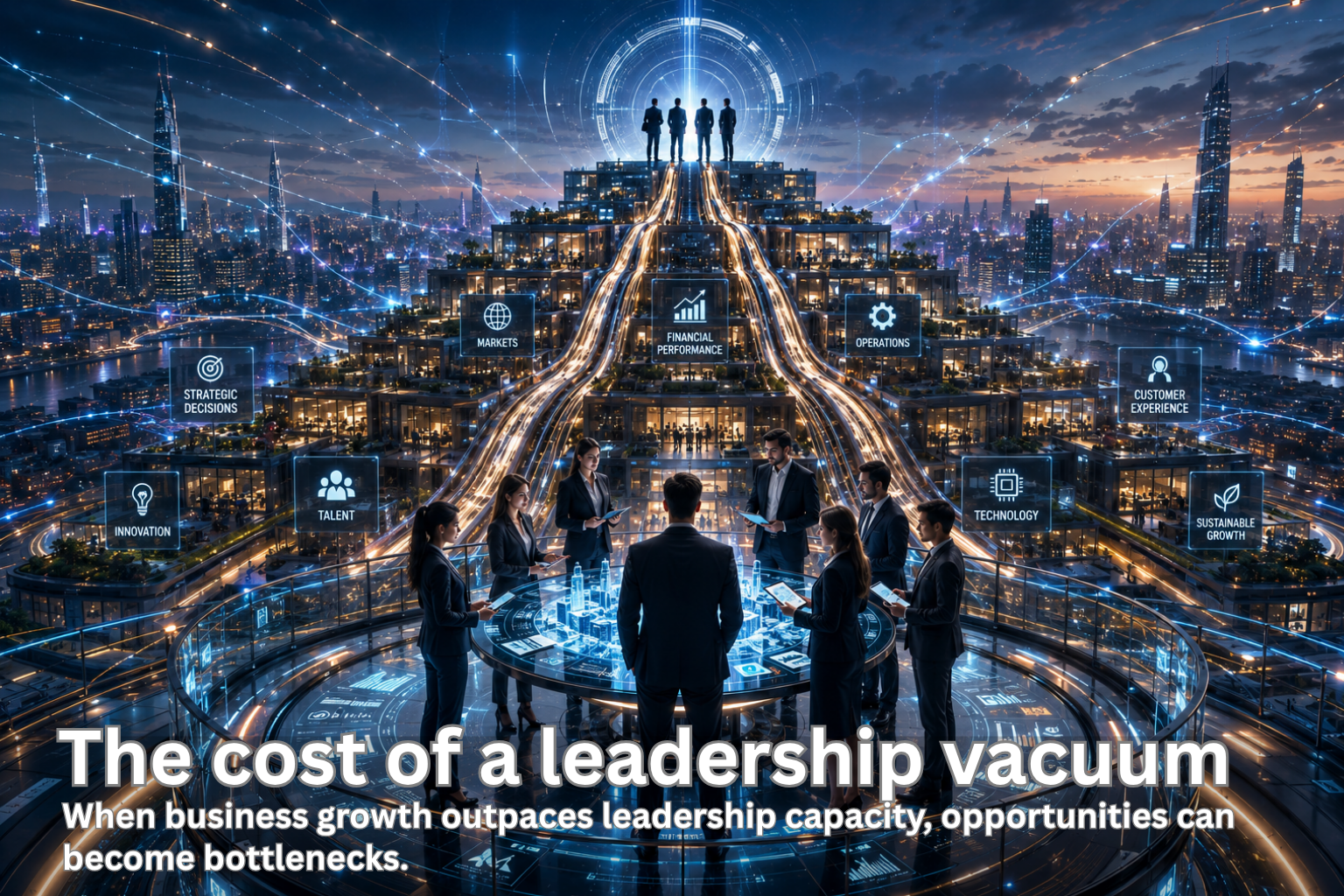
When a business grows faster than its leadership structure, a vacuum can develop. Decisions slow down, accountability becomes unclear and senior teams can become overwhelmed by operational demands.
The result? Growth can become harder, more expensive and more risky than it needs to be.
What is a Leadership Vacuum? 🔍
A leadership vacuum doesn't necessarily mean there are no leaders in the business.
Instead, it can occur when:
- Leadership responsibilities have become unclear.
- Existing executives are stretched too thin.
- Critical senior positions remain unfilled.
- The organisation has outgrown its existing management structure.
- Key decisions depend too heavily on one or two individuals.
What worked when a business had 20 employees may not work when it has 100, and the leadership model that supported yesterday's growth may not be enough for tomorrow's ambitions.
The Hidden Cost of Leadership Gaps 💷
The cost of a leadership vacancy goes far beyond the salary of an empty position.
⏳ 1. Slower Decision-Making
When ownership isn't clear, decisions can take longer.
Teams may wait for approval, senior executives may become involved in too many operational decisions and opportunities can lose momentum.
In a competitive market, delayed decisions can quickly become missed opportunities.
🔥 2. Pressure on Existing Leaders
When a senior position remains vacant, the responsibility often falls on other members of the leadership team.
This can lead to:
- Longer working hours
- Reduced strategic focus
- Leadership fatigue
- Increased risk of burnout
- Less time for innovation and growth
Strong leaders can carry additional responsibility for a period of time, but this is rarely a sustainable long-term solution.
🤝 3. Impact on Employee Engagement
People need clarity about where the organisation is heading and who is responsible for making key decisions.
A leadership gap can create uncertainty across teams. Employees may become frustrated by changing priorities,
inconsistent communication or a lack of direction.
Good leadership creates confidence. Leadership uncertainty can create disengagement.
📉 4. Missed Growth Opportunities
Growth often requires businesses to make important moves quickly, entering new markets, launching products, restructuring teams or developing new commercial strategies.
Without the right leadership expertise in place, these opportunities may be delayed or poorly executed.
The question isn't simply:
"Can we afford to hire a senior leader?"
It's also:
"Can we afford not to?"
Growth Requires Leadership to Evolve 🌱
As an organisation develops, its leadership requirements change too.
A founder-led business may eventually need experienced executives who can build scalable systems, develop high-performing teams and manage increasing complexity.
Businesses should therefore regularly ask:
- What leadership capabilities will we need over the next 12–24 months?
- Where are our current leadership bottlenecks?
- Are we too dependent on individual people?
- Which roles will become critical as we grow?
- Do our existing leaders have the capacity to support the next stage?
Planning ahead can prevent a temporary leadership gap from becoming a major business problem.
Finding the Right Leadership Matters 🎯
Filling a vacancy quickly is not always the answer.
A senior appointment needs to deliver more than an impressive CV. The right leader should understand the organisation's ambitions, complement its culture and have the experience required to navigate its next stage of development.
This is where executive search can play an important role.
A thorough search process considers:
- Strategic objectives
- Leadership capability
- Cultural alignment
- Industry experience
- Future potential
- The specific challenges facing the organisation
The goal isn't simply to fill a seat.
It's to find the leader who can make a meaningful difference. ⭐
Leadership Is an Investment 💡
During periods of growth, businesses naturally focus on revenue, customers, technology and operational efficiency.
But leadership should be treated as an equally important investment.
A strong leadership team can help an organisation:
- Make better decisions
- Build accountability
- Retain key talent
- Navigate change
- Identify new opportunities
- Create sustainable growth
On the other hand, leaving critical leadership gaps unresolved can create costs that aren't immediately visible on the balance sheet.
Don't Wait for a Leadership Crisis 🚨
The best time to identify a leadership gap is before it becomes a crisis.
By anticipating future requirements and understanding where additional leadership expertise will be needed, businesses can prepare for growth rather than simply react to it.
🚀 Growth creates opportunity.
🎯 Leadership turns opportunity into execution.
🤝 The right people help make growth sustainable.
For businesses entering an exciting new phase, investing in leadership capability today can help create a stronger, more resilient organisation for tomorrow.
At Wyman Bain, we understand the importance of finding leaders who can make an impact, not just today, but throughout the next stage of a business's growth.