Manufacturing Leadership in the Age of Automation and AI 🤖🏭
Manufacturing Leadership in the Age of Automation and AI 🤖🏭
Manufacturing is entering a decisive era. Automation, artificial intelligence (AI), advanced robotics and data analytics are fundamentally reshaping how organisations operate,
compete and scale. What was once a gradual evolution has become a strategic imperative.
Yet despite significant investment in technology, many manufacturing transformations fail to deliver their intended value. The reason is rarely technical.
It is almost always a
leadership issue.
At Wyman Bain, we see a clear pattern: organisations that succeed in automation-led transformation are those led by
executives who can align technology, people and strategy, not treat them as separate agendas.
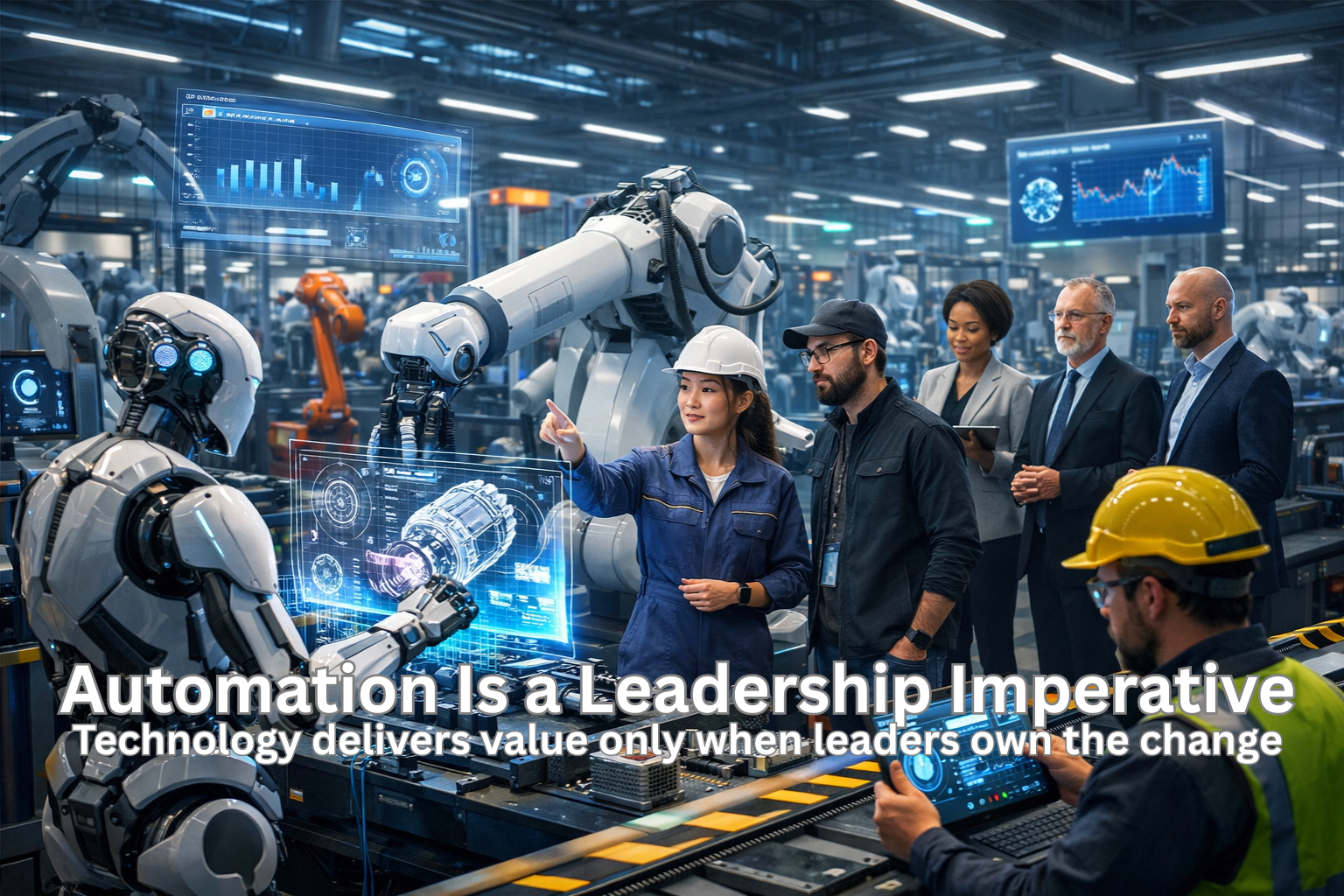
Automation Is a Leadership Imperative ⚙️
Automation and AI promise efficiency, resilience and improved decision-making. However, these benefits are only realised when leadership teams understand that transformation is not confined to the factory floor or IT function.
Senior leaders must address:
- How automation supports long-term commercial and growth objectives
- The organisational and cultural impact of technology adoption
- Governance, accountability and risk management in data-driven environments
- The pace of change relative to workforce capability and readiness
Without clear leadership ownership, automation initiatives often become fragmented, underutilised or resisted, eroding return on investment.
The Changing Profile of Manufacturing Leaders 👥
Historically, manufacturing leadership has prioritised operational excellence, engineering expertise and process discipline. While these remain critical, they are no longer sufficient on their own.
Today’s manufacturing leaders must demonstrate:
- Digital literacy - not coding expertise, but the ability to ask the right questions of data, systems and technology teams
- Strategic integration - connecting automation investment to productivity, customer outcomes and competitive positioning
- Change leadership - guiding organisations through uncertainty with clarity and credibility
- Emotional intelligence - managing legitimate workforce concerns around role evolution and job security
The most effective leaders act as integrators, bridging technology, operations, commercial strategy and people.
Leading Workforce Transformation, Not Displacement 🔧📊
One of the most critical leadership challenges in automation is workforce transformation. While certain tasks will be automated, demand is increasing for higher-value skills across analytics, systems oversight, digital maintenance and continuous improvement.
High-performing leaders focus on:
- Forward-looking workforce planning aligned to automation roadmaps
- Reskilling and upskilling initiatives that protect organisational knowledge
- Clear, honest communication that builds trust and engagement
- Partnering with HR, education providers and external advisors to secure future capability
Where leaders treat automation as a people strategy, not a cost-reduction exercise, engagement,
productivity and retention all improve.
Why
Executive Hiring Must Change 💡
Despite the scale of change underway, many organisations continue to appoint leaders based on past success in traditional operating models. This creates a disconnect between transformation ambition and leadership capability.
Effective executive assessment now requires:
- Evidence of leading complex, multi-dimensional change
- Experience operating in data-rich, technology-enabled environments
- Cultural adaptability across legacy and modern systems
- The ability to lead multidisciplinary and often geographically dispersed teams
At Wyman Bain, our executive search and market intelligence approach is designed to identify leaders who can
deliver sustainable transformation, not just maintain
operational stability.
Competitive Advantage Will Be Led, Not Installed 🚀
Automation and AI will continue to redefine manufacturing over the coming decade. However, technology alone will not determine which organisations succeed.
Competitive advantage will belong to those businesses led by executives who understand that:
- Transformation is continuous, not episodic
- Leadership credibility is essential during periods of change
- Culture and capability ultimately determine technology value
Manufacturing leadership in the age of automation is no longer about keeping operations running efficiently. It is about
shaping resilient, future-ready organisations.
How
Wyman Bain Supports Manufacturing Organisations
Wyman Bain partners with manufacturing and industrial businesses to deliver executive search,
succession planning and market intelligence solutions that support automation-led transformation and long-term growth.
If you would like to discuss how leadership capability can accelerate your automation strategy, our team would be pleased to support you.