Leadership Agility: A Critical Skill for Modern Executives 🚀
Leadership Agility: A Critical Skill for Modern Executives 🚀
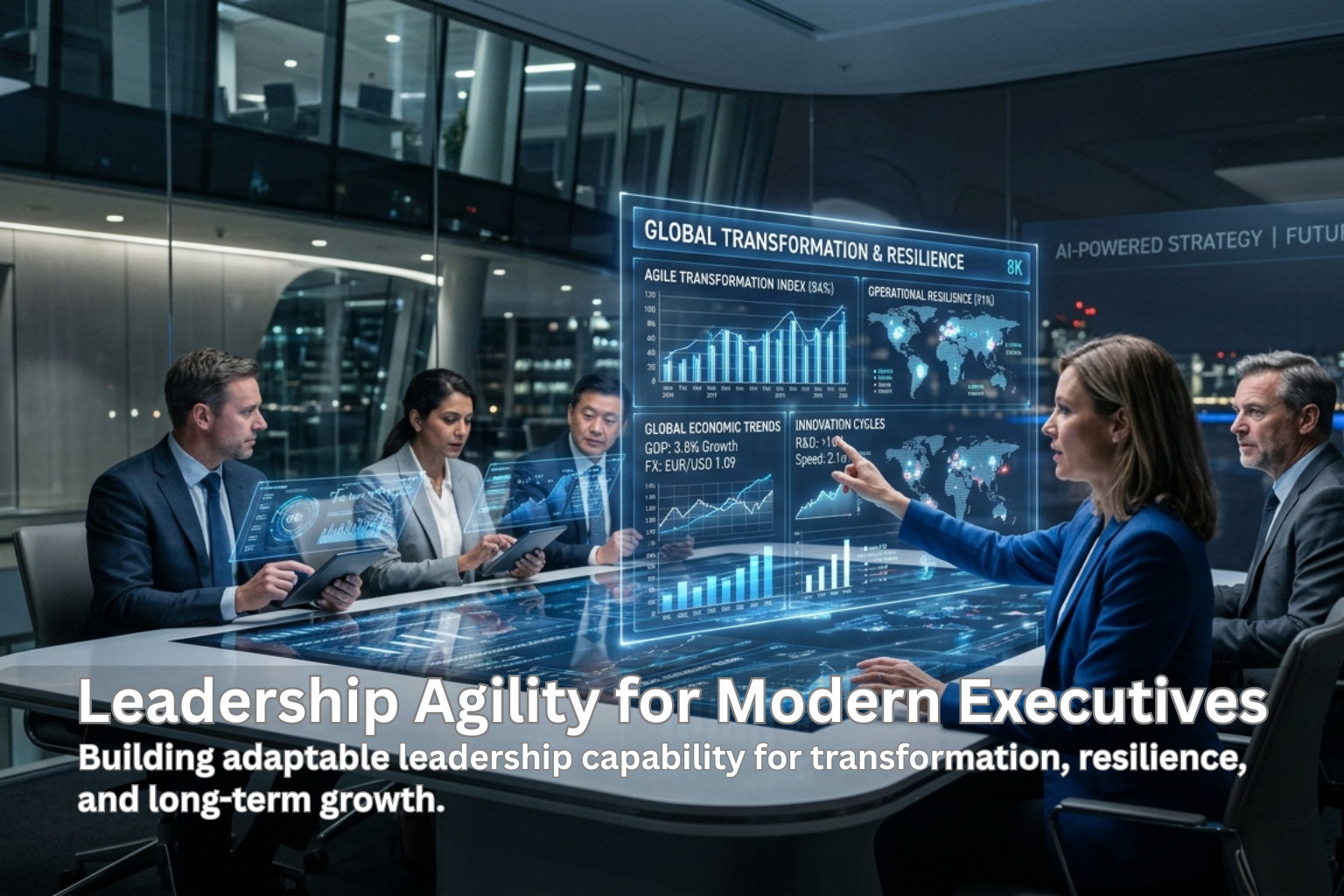
The business world is evolving faster than ever before. Organisations are facing constant disruption driven by digital transformation, AI adoption, economic uncertainty and changing workforce expectations. In this environment, leadership is no longer simply about maintaining stability.
It is about adapting confidently through continuous change. 🌍
At Wyman Bain, we consistently see that the organisations performing strongest over the long term are those investing in agile, adaptable leadership capability alongside operational performance and strategy.
Because modern leadership is no longer defined only by experience.
It is defined by the ability to evolve. 🌱
Why
Leadership Agility Matters More Than Ever 🧠
Today’s executives are expected to lead through complexity while maintaining performance, engagement and strategic clarity. They are balancing digital transformation, workforce shifts, operational pressures and rising stakeholder expectations all at once.
The leaders who succeed are not necessarily the ones with all the answers.
They are the ones who can remain calm under pressure, adapt quickly and guide organisations confidently through uncertainty. 🚀
What Agile
Leaders Do Differently 🌍
Agile leaders create environments where organisations can evolve without losing focus or momentum.
They are:
🔄 Adaptable during periods of disruption and change
📊 Commercially aware and data-informed
🤝 Collaborative across teams and functions
🌱 Open to learning and new
perspectives
🚀 Comfortable making decisions in uncertainty
Most importantly, they understand that leadership is not about controlling every situation.
It is about creating clarity, trust and direction when conditions are constantly changing.
Leadership Agility Shapes Organisational
Culture 🤝
Leadership behaviour directly influences how teams respond to pressure, change and uncertainty. When leaders demonstrate adaptability, openness and resilience, those behaviours spread throughout the organisation.
Teams become more collaborative. Innovation improves. Employees feel safer contributing ideas and navigating change. 🌱
By contrast, rigid leadership often creates:
⚠️ Resistance to change
⚠️ Slower
execution
⚠️ Lower engagement
⚠️ Organisational silos
In fast-moving industries, culture becomes a significant competitive advantage.
And culture is shaped by leadership every single day.
The Leadership
Challenge Organisations Face ⚠️
Many organisations still promote leaders primarily based on technical expertise, operational performance or industry tenure. While experience remains valuable, it does not automatically prepare executives to lead through transformation.
Modern organisations require leaders who can:
📈 Balance
strategy with execution
🤝 Lead people through uncertainty
🌍 Adapt to evolving business conditions
🚀 Sustain performance during continuous change
Without leadership agility, even strong organisations can struggle to maintain momentum in rapidly changing
markets.
The
Wyman Bain Approach 🧩
At Wyman Bain, we help organisations build leadership teams capable of driving transformation, resilience and long-term growth.
Our focus includes executive search, leadership assessment, succession planning and strengthening agile leadership capability across organisations. We partner with businesses to align leadership strategy with future commercial priorities, operational resilience and organisational culture. 🌱
Because sustainable success is not created through strategy alone.
It is sustained through leadership.
Conclusion 🚀
Leadership agility is no longer optional for modern executives.
It is essential.
The organisations that thrive in the future will be those led by individuals who can adapt quickly, communicate clearly and lead confidently through uncertainty.
Because ultimately, long-term business success is not defined only by technology or strategy.
It is defined by leadership. 🌍
CONTACT US >>>>>>>