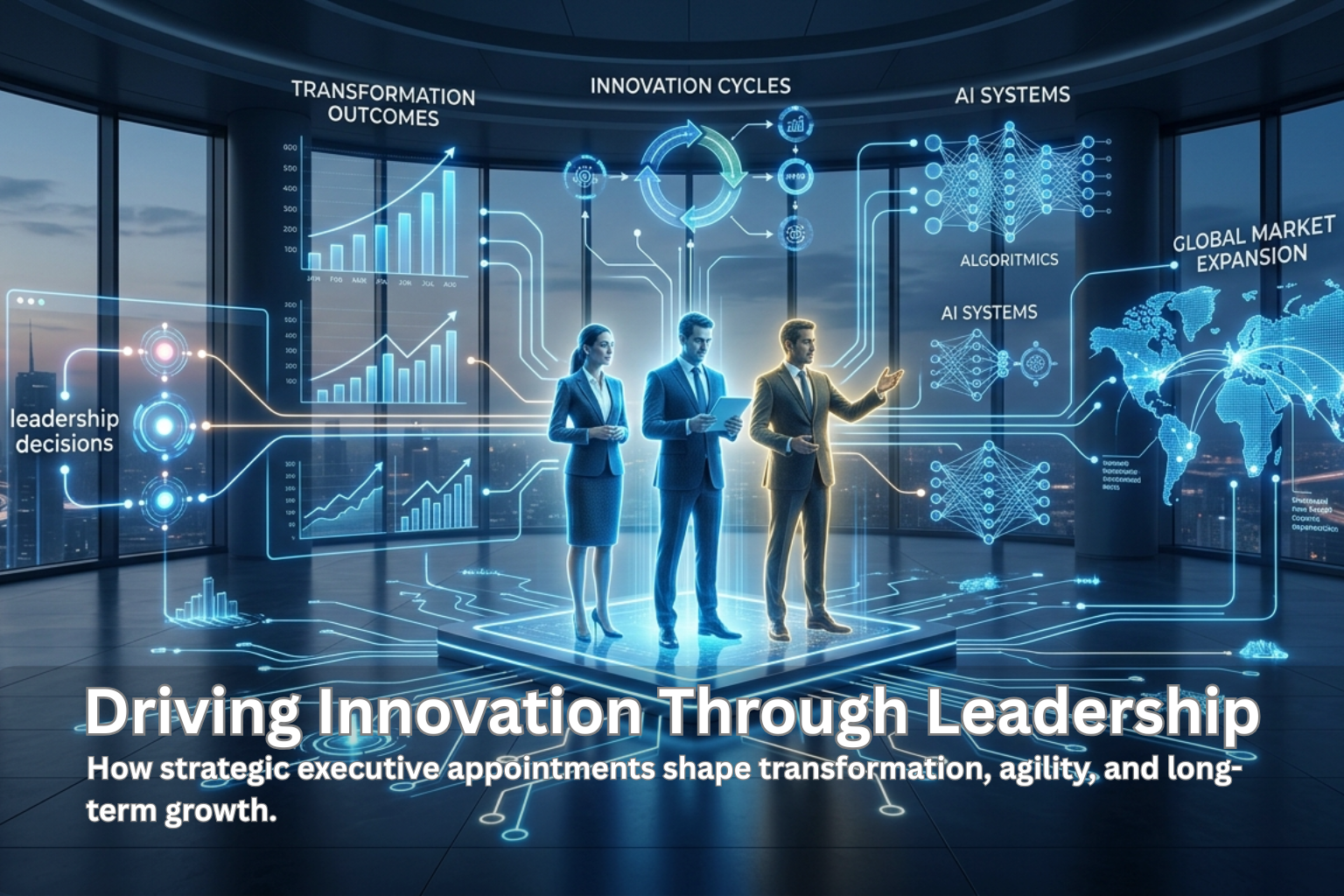
Driving Innovation Through Strategic Executive Appointments 🚀
Driving Innovation Through Strategic Executive Appointments 🚀
Innovation is no longer a competitive advantage reserved for a handful of organisations.
It has become essential for long-term growth, resilience and
market relevance.
Across
industries, businesses are navigating:
📈 Rapid market change
💻 Digital transformation
🌍 Evolving customer expectations
⚖️ Economic uncertainty
🤖 Emerging
technologies and AI adoption
🔗 Increasing operational complexity
Yet while many organisations invest heavily in technology and transformation initiatives, sustainable innovation is rarely achieved through systems alone.
At Wyman Bain, we consistently see that the organisations leading innovation successfully are those making strategic executive appointments aligned to future business needs.
Because innovation is not simply about ideas.
It is about leadership. 🧠
Why
Leadership Is the Real Driver of Innovation 🌱
Innovation requires more than creativity or ambition.
It requires leaders who can:
🎯 Create strategic clarity
🚀 Lead transformation with confidence
🤝 Encourage collaboration across teams
📢 Communicate
vision and direction clearly
⚙️ Balance innovation with operational discipline
📈 Turn ideas into measurable business outcomes
Without strong leadership, even the best innovation strategies often struggle to deliver sustainable impact.
The organisations that outperform are those building leadership teams capable of adapting quickly, making decisions under pressure and creating
cultures where innovation can thrive.
The
Executive Leadership Profile Is Changing 🌍
The expectations placed on executive leaders are evolving rapidly.
Traditional leadership models focused heavily on operational control and industry expertise.
Today’s organisations require something broader.
The most effective innovation-focused leaders are:
🔄 Adaptable in fast-changing environments
💡 Curious and future-focused
📊 Data-informed and commercially aware
🤝
Collaborative across functions and teams
🌱 Comfortable leading uncertainty and change
🚀 Focused on long-term value creation rather than short-term reaction
Technical expertise remains important.
But leadership capability now determines whether transformation succeeds or stalls.
Culture and Innovation Are Deeply Connected 🤝
Innovation cannot flourish in environments where:
⚠️ Employees fear failure
⚠️ Decision-making is overly rigid
⚠️ Collaboration is limited
⚠️ Communication lacks transparency
⚠️ Teams operate in silos
The strongest
organisations intentionally build cultures where:
🚀 New ideas are encouraged
📚 Continuous learning is valued
🤝 Diverse perspectives are welcomed
🌱 Experimentation is supported responsibly
📈 Accountability and performance remain clear
Executive appointments have a direct impact on this culture.
Because leaders shape organisational behaviour through what they prioritise, reward and tolerate every day.
The
Risk of Hiring for Experience Alone ⚠️
One of the most common mistakes organisations make is hiring executives based solely on credentials, titles or technical expertise.
Experience matters.
But innovation leadership requires more than experience alone.
Common hiring gaps include:
❌ Prioritising stability when transformation is needed
❌ Overlooking adaptability and change leadership
❌ Ignoring
cultural alignment
❌ Underestimating communication and influence capability
❌ Focusing only on past success rather than future potential
The strongest executive appointments combine:
🧠
Strategic thinking
📈 Commercial awareness
🤝 People leadership
🚀 Transformation capability
🌍 Adaptability under pressure
Because sustainable innovation depends on leadership that can evolve with the business.
Building Leadership Teams for Long-Term Growth 🌟
Forward-thinking organisations treat executive hiring as a strategic investment in future performance.
They focus on:
🔄
Succession planning and leadership continuity
🎯 Assessing leadership potential beyond CVs
🌱 Strengthening leadership depth across the organisation
🤝 Aligning leadership with organisational culture
🚀 Building agile and resilient executive teams
📈 Supporting long-term transformation and growth
The businesses creating sustainable competitive advantage are those investing intentionally in both innovation and leadership capability.
Because growth is sustained through people, not just strategy.
The
Wyman Bain Approach 🧩
At Wyman Bain, we partner with organisations to build leadership teams capable of driving innovation, transformation and long-term value creation.
Our focus includes:
🎯
Executive search and leadership assessment
🚀 Innovation and transformation leadership capability
🤝 Organisational and cultural alignment
🌱 Succession planning and leadership pipeline development
📈 Leadership strategies aligned to business growth
🌍 Building executive teams prepared for future complexity
We help organisations strengthen not only leadership performance, but the long-term resilience and adaptability of the business itself.
Conclusion 🚀
Innovation is no longer optional.
It is fundamental to future business success.
But innovation does not succeed through technology alone.
It succeeds through leadership that can inspire change, align people and execute with clarity under pressure.
The organisations that lead the future will be those making strategic executive appointments that strengthen culture, adaptability and long-term capability.
Because ultimately, innovation is driven by people. 🌱
CONTACT US >>>>>>>