How Geopolitical Shifts Are Reshaping C-Suite Profiles in Defence Industries 🌍🛡️
How Geopolitical Shifts Are Reshaping C-Suite Profiles in Defence Industries 🌍🛡️
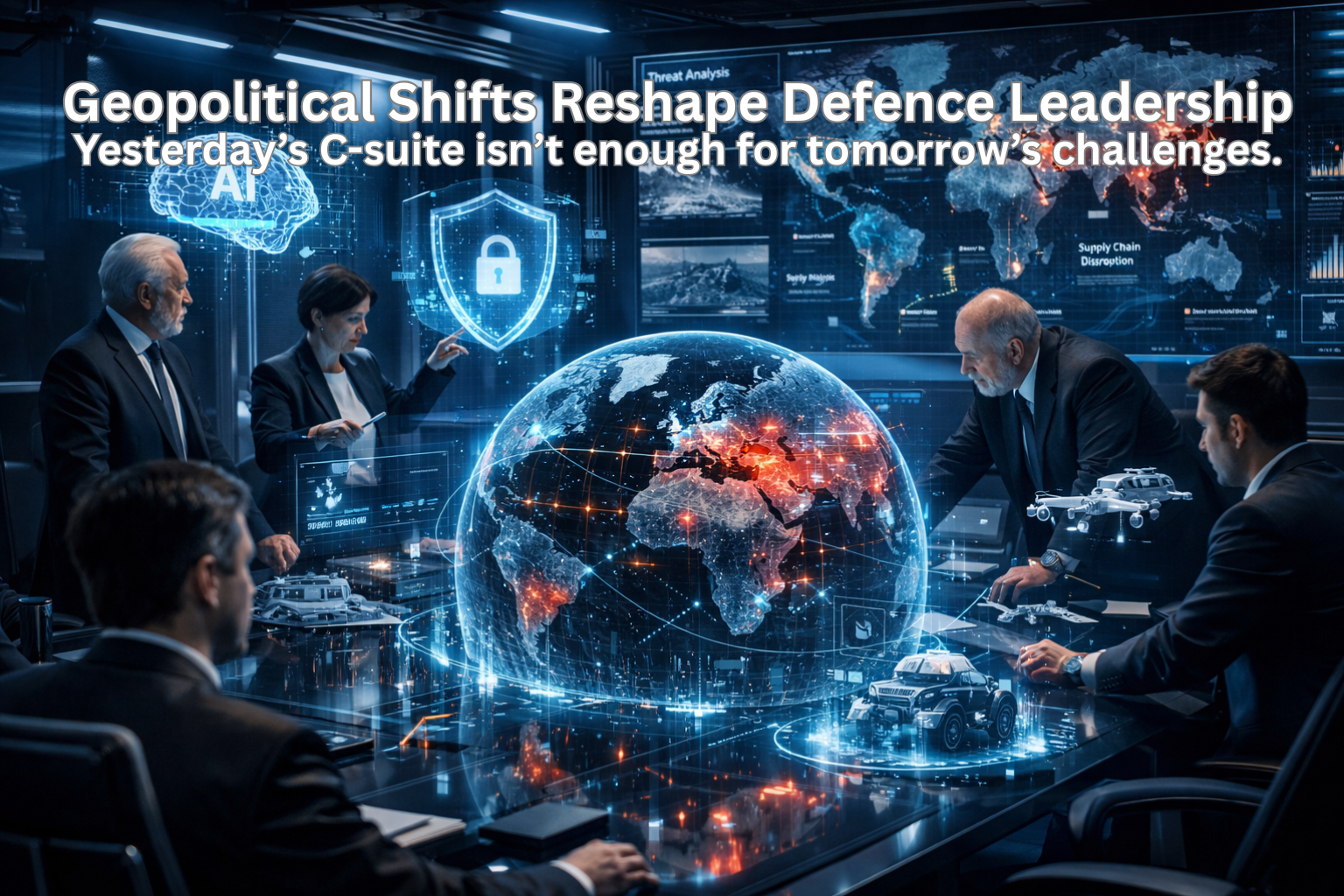
The global security order is entering a new phase. Rising geopolitical tension, rearmament across Europe, technological rivalry and renewed emphasis on sovereign capability are transforming the defence sector.
For boards and investors, the implication is clear:
Yesterday’s leadership model is no longer sufficient for tomorrow’s
defence environment.
At Wyman Bain, we partner with defence primes, advanced engineering firms and private equity stakeholders. We are seeing a decisive evolution in what constitutes an effective C-suite within defence.
This is not incremental change. It is structural.
A New
Strategic Context ⚖️
Defence organisations now operate amid:
• Sustained increases in UK and NATO-aligned defence expenditure 💷
• Accelerated procurement and compressed delivery cycles ⏱️
• Tighter export controls and regulatory scrutiny 📜
• Intensifying cyber and hybrid threats 💻
•
Supply chain fragmentation and reshoring priorities 🔗
• Heightened public and political accountability 🏛️
In this environment, executive leadership must balance commercial performance with national responsibility, often under significant scrutiny.
Operational excellence alone is no longer enough.
The Redefined
Defence C-Suite 🔄
1. Strategic Foresight at the Top 🧭
CEOs and COOs must now interpret geopolitical volatility as a core business variable. Scenario planning, policy literacy and alliance awareness are essential competencies.
Modern defence leaders act not only as corporate executives, but as strategic navigators operating within complex state ecosystems.
2.
Financial Leadership in a Sovereign Funding Model 💷
With long-term public funding commitments expanding, CFOs require:
• Deep understanding of government contracting frameworks
• Expertise in multi-year programme financing
• Mastery of compliance, audit and risk transparency
• Capital discipline aligned with national priorities
Financial rigour must be matched with diplomatic awareness.
3. Digital and Cyber Authority at Board Level 💻
The convergence of defence capability and digital capability is accelerating.
Artificial intelligence, autonomous systems, secure data architecture and cyber resilience are now strategic differentiators. As a result:
• CTO and CIO roles are gaining board-level prominence
• Cyber literacy is becoming mandatory across the
executive team
• Digital transformation experience is mission-critical
Technology is no longer supportive infrastructure, it is operational backbone.
4. Supply Chain Sovereignty and Resilience 🔗
Sanctions regimes, geopolitical fragmentation and material shortages have exposed structural vulnerabilities.
C-suite leaders must now prioritise:
• Sovereign
manufacturing capability
• Reshoring and nearshoring strategies
• Diversified supplier ecosystems
• ESG-aligned procurement frameworks 🌱
Resilience has become a competitive advantage.
5. Governance,
Ethics and Reputation 🏛️
Defence companies operate at the intersection of politics, security and public trust.
Modern executives must demonstrate:
• Clear ethical judgement
• Robust compliance governance
• Transparent stakeholder engagement
• Disciplined reputation management
Credibility at board level increasingly determines licence to operate.
The Emerging Defence
Executive Profile 🎯
We are seeing sustained demand for leaders who combine:
✔ Geopolitical and policy fluency
✔ Advanced programme execution capability
✔ Digital and cyber literacy
✔ Financial sophistication within public-sector environments
✔ Governance strength and ethical clarity
✔ Calm, decisive leadership under pressure
The modern defence executive must operate confidently at the intersection of strategy, technology and statecraft.
Leadership as the
Strategic Differentiator 🚀
The reshaping of the defence C-suite is not cyclical, it reflects a long-term reordering of global security priorities.
As defence investment rises and alliances recalibrate, leadership capability will determine which organisations:
• Secure major programme mandates
• Navigate regulatory complexity
• Attract long-term capital
• Sustain operational resilience
Boards that proactively redefine executive profiles, rather than relying on legacy leadership archetypes, will be best positioned to thrive in a more contested world.
At
Wyman Bain, we support defence organisations in aligning executive capability with geopolitical reality. Our focus is clear: ensuring leadership strength matches strategic ambition.
In a period defined by uncertainty, leadership is no longer a supporting factor.
It is the decisive advantage. 🛡️🌍
CONTACT US >>>>>>>>>>