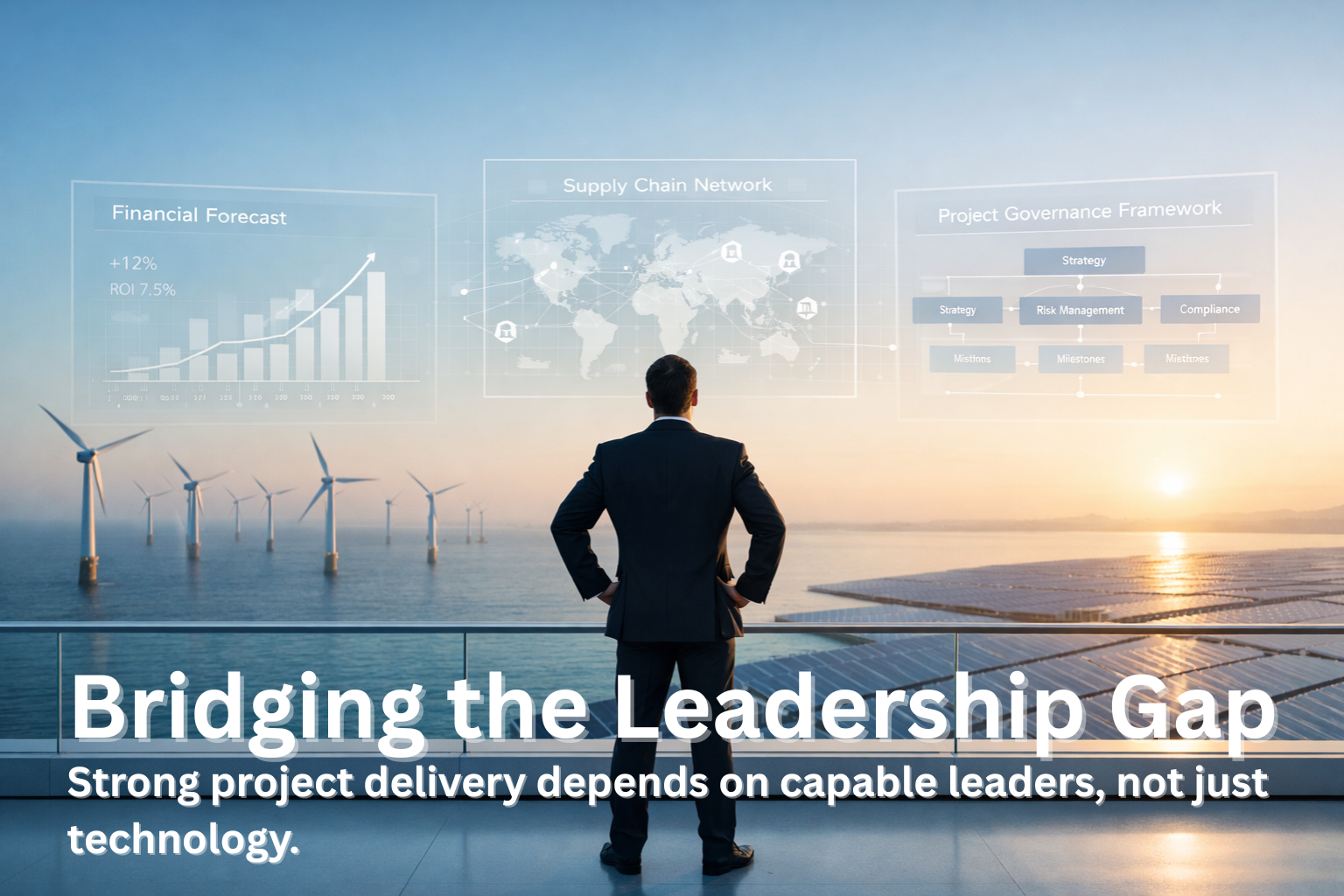
Bridging the Skills Gap for Offshore Wind and Solar Project Leaders 🌬️☀️
Bridging the Skills Gap for Offshore Wind and Solar Project Leaders 🌬️☀️
The
energy transition is no longer a future ambition, it is an operational reality. Across the UK and globally, offshore wind and solar capacity targets are accelerating at pace, supported by strong policy frameworks and growing investor confidence.
Yet behind this momentum lies a structural challenge that risks constraining delivery:
A widening leadership skills gap.
At
Wyman Bain, we work alongside renewable energy developers, infrastructure funds and EPC partners. Increasingly, we see that project success is determined not only by engineering excellence or
financial backing, but by the depth and quality of leadership guiding delivery.
The Scale and Complexity of Modern
Renewable Projects 🌍
Today’s offshore wind and solar projects are more complex than ever before.
Offshore wind developments are moving into deeper waters, incorporating floating technologies and larger turbine capacities. Solar portfolios are integrating battery storage, digital monitoring systems and grid-balancing capabilities.
Project leaders must navigate:
- Multi-billion-pound capital programmes
- International supply chains and procurement risk
- Evolving regulatory and planning frameworks
- Community and environmental scrutiny
- Tight construction schedules and performance guarantees
The pace of expansion has outstripped the pipeline of leaders equipped to manage this scale of complexity.
Why the Leadership Gap Is Growing ⚙️
Several structural factors are contributing to the shortage:
Rapid Market Expansion 🚀
Government targets and private investment have accelerated faster than leadership development pathways.
Cross-Sector Competition 🔄
Oil & gas, infrastructure, defence and major capital projects compete for comparable executive talent.
Rising Technical Sophistication 🧪
Floating wind, hybrid solar-plus-storage systems and digital asset management demand broader technical literacy.
Generational Transition 👥
Experienced project directors are retiring, while emerging leaders require structured development to assume comparable responsibility.
The result is a leadership bottleneck at precisely the moment when scale and execution discipline are most critical.
The
Capabilities Defining High-Impact Project Leaders 🎯
Bridging the gap begins with clarity around the capabilities required.
1. Integrated Systems Leadership 🌐
The ability to align engineering, procurement, grid integration and compliance within a cohesive delivery strategy.
2. Commercial and Financial Sophistication 💷
Confidence in navigating Contracts for Difference (CfDs), power purchase agreements (PPAs), structured financing and risk allocation frameworks.
3. Regulatory and Stakeholder Acumen 📜
Expertise in planning processes, maritime regulation and community engagement.
4. Supply Chain Governance 🔗
Managing global suppliers amid geopolitical volatility and material cost fluctuations.
5. Strategic Resilience 🌊
Maintaining performance and direction in the face of weather disruption, cost pressures and policy shifts.
Modern renewable leaders must blend operational rigour with strategic foresight.
Closing the Gap: A Strategic Imperative 🏗️
Addressing the leadership shortage requires a deliberate, long-term approach.
Strengthen Leadership Pipelines 📚
Formal succession planning, mentoring and executive development programmes are essential to future-proof capability.
Broaden Talent Horizons 🌍
Cross-sector recruitment can unlock transferable expertise from large-scale infrastructure and capital project environments.
Embed Governance Excellence 🏛️
Clear accountability structures, risk management frameworks and performance oversight enable emerging leaders to succeed.
Reinforce Purpose and Culture 🌱
Top-tier talent is increasingly motivated by authentic commitment to decarbonisation and societal impact.
Organisations that take a proactive approach to leadership development will gain a decisive competitive advantage.
Leadership as the Decisive
Differentiator 🚀
Offshore wind and solar are foundational to the UK’s net-zero strategy. However, infrastructure deployment will advance only as quickly as leadership capability allows.
Those organisations that invest early in executive capability will:
- De-risk complex capital programmes
- Improve project delivery certainty
- Enhance investor confidence
- Protect long-term asset value
At
Wyman Bain, we partner with renewable energy leaders to strengthen governance, executive capability and strategic alignment across complex project portfolios. Our focus is clear: ensuring leadership capacity matches growth ambition.
The future of offshore wind and solar will not be defined solely by installed capacity, but by the strength, discipline and vision of the leaders delivering it. 🌬️☀️
If your organisation is scaling renewable infrastructure, now is the time to ensure your leadership capability is as robust as your investment strategy.
CONTACT US >>>>>>>>>>>