Leadership Traits That Accelerate Hydrogen Economy Growth 🚀🌍
Leadership Traits That Accelerate Hydrogen Economy Growth 🚀🌍
The hydrogen economy is no longer a distant ambition, it is a strategic imperative. As nations intensify their net-zero commitments and industries seek viable decarbonisation pathways, hydrogen is emerging as a critical enabler of deep, system-wide transformation.
Yet
technology, capital and policy frameworks alone will not unlock hydrogen’s full potential. Progress at scale demands
exceptional leadership, leaders capable of navigating complexity, aligning ecosystems and turning long-term ambition into measurable results.
At
Wyman Bain, we work alongside organisations shaping the future of
energy. We have seen first-hand that the acceleration of the hydrogen economy depends not merely on innovation, but on the calibre of leadership driving it.
Below are the defining leadership traits accelerating hydrogen growth across the UK and globally.
1. Vision Anchored in Commercial Reality 🔭💼
Hydrogen markets are evolving rapidly, shaped by policy incentives, technological advancements and shifting investor sentiment. Effective leaders combine bold, future-focused vision with grounded commercial discipline.
They are able to:
- Identify scalable opportunities within emerging value chains
- Balance long-term infrastructure investment with short-term performance metrics
- Build credible business cases in uncertain markets
Vision without commercial rigour creates
risk. Commercial rigour without vision limits impact. The strongest leaders integrate both.
2. Systems Thinking Across the
Energy
Ecosystem 🌐🔗
Hydrogen does not function in isolation. It intersects with renewables, carbon capture, power markets, heavy industry, mobility and grid infrastructure.
Leaders accelerating hydrogen adoption understand interdependencies across:
- Production (green, blue and emerging pathways)
- Storage and transport logistics
- Industrial demand centres
- Regulatory and policy frameworks
A systems-level perspective ensures strategic alignment across the entire value chain, reducing bottlenecks and enhancing long-term viability.
3. Policy
Intelligence
and Regulatory Agility 📜⚖️
The hydrogen economy is deeply influenced by public policy, from Contracts for Difference and production incentives to carbon pricing and certification standards.
High-impact leaders:
- Engage constructively with government and regulators
- Anticipate policy evolution and funding mechanisms
- Align strategy with national and international decarbonisation goals
Policy intelligence is not simply compliance, it is strategic positioning.
4. Courageous
Capital Deployment
💷🔥
Hydrogen projects are capital-intensive, often requiring significant upfront investment before stable revenue streams are established.
Leaders in this space demonstrate:
- Confidence in long-term market fundamentals
- The ability to secure institutional investor trust
- A disciplined yet forward-thinking approach to risk
Calculated boldness distinguishes market shapers from market followers.
5. Technical Fluency with
Strategic
Clarity 🧪📊
Hydrogen development involves complex technological choices, from electrolysis efficiency to storage mediums and transport solutions.
While leaders need not be engineers, they must possess sufficient technical fluency to:
- Evaluate competing technologies
- Understand cost curve trajectories
- Make informed strategic trade-offs
Technical credibility strengthens
boardroomconfidence and stakeholder trust.
6. Cross-Sector Collaboration & Partnership
Building
🤝🌍
Hydrogen ecosystems require unprecedented collaboration between:
- Energy producers
- Industrial off-takers
- Infrastructure developers
- Financial institutions
- Government bodies
No single organisation can build the hydrogen economy alone. Leaders who foster transparent, mutually beneficial partnerships accelerate deployment and de-risk projects.
7. Resilience in the Face of
Market
Volatility 🌊🛠️
Energy markets are cyclical. Policy priorities evolve. Supply chains fluctuate. Technology costs shift.
Sustainable hydrogen leadership requires:
- Long-term strategic patience
- Adaptability to changing economic conditions
- Decisive course correction when required
Resilience transforms short-term disruption into long-term advantage.
8. Integrity and Authentic Commitment to
Decarbonisation
🌱✨
As scrutiny around greenwashing intensifies, credibility matters more than ever.
Leaders accelerating hydrogen growth prioritise:
- Verifiable emissions reductions
- Transparent reporting and governance
- Responsible sourcing and community engagement
Authentic sustainability is not a communications strategy, it is a strategic imperative.
The Strategic Leadership Imperative 🚀
The hydrogen economy represents one of the most significant industrial transformations of our generation. However, infrastructure, innovation and investment will only move at the pace of leadership.
Organisations that
cultivate visionary, commercially astute and collaborative leaders will shape markets rather than react to them.
At
Wyman Bain, we partner with energy innovators, infrastructure developers and policy stakeholders to strengthen leadership capability in complex, capital-intensive environments. Our approach integrates strategic insight, governance excellence and commercial acumen to help organisations lead confidently within the evolving hydrogen landscape.
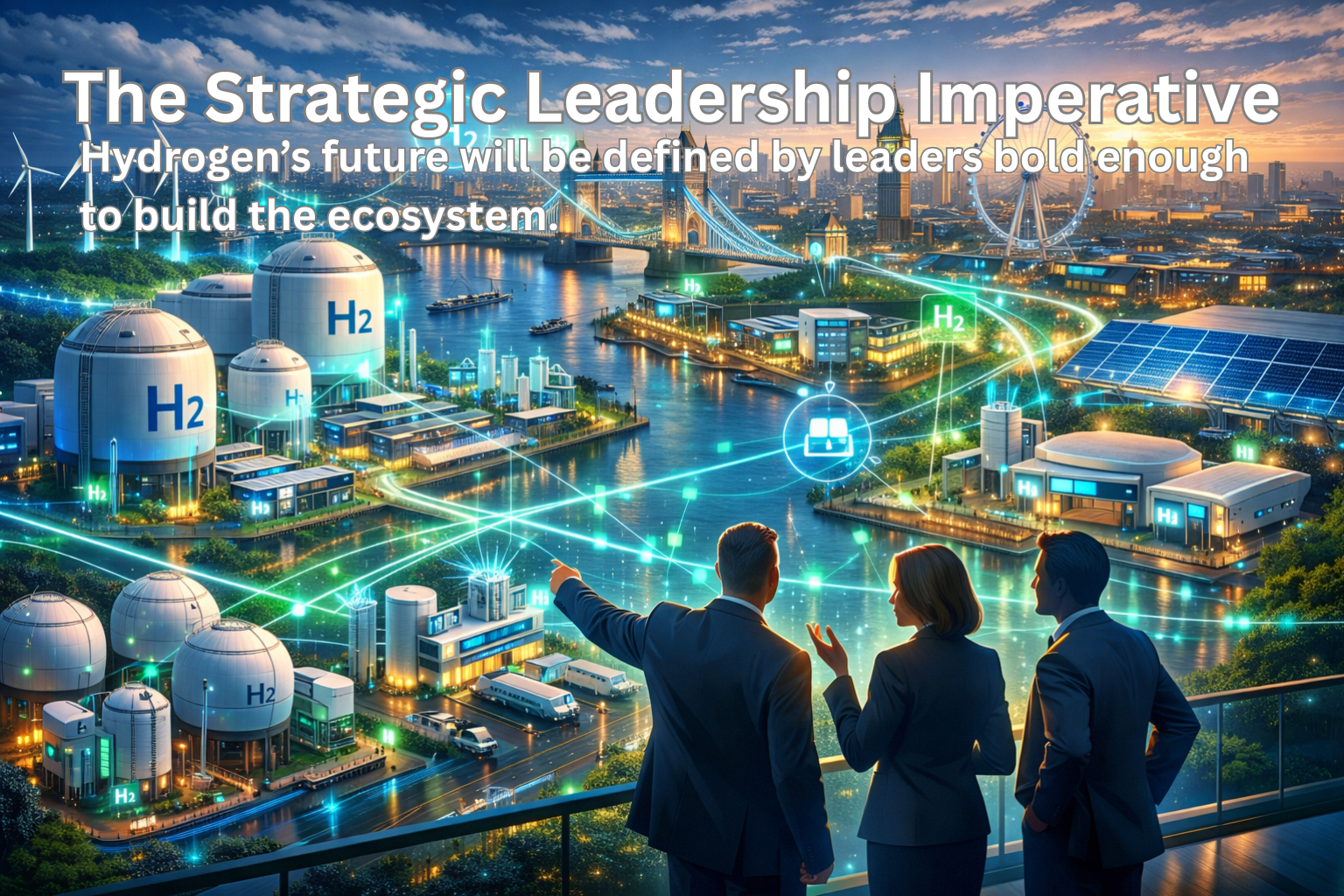
Hydrogen’s future will not be defined solely by technology breakthroughs, it will be defined by the leaders bold enough to build the ecosystem around them. 🌍
If your organisation is positioning itself within the hydrogen value chain, now is the time to ensure your leadership capability matches your strategic ambition.
CONTACT US >>>>>>>>>>