
How Effective Boards Balance Risk and Opportunity ⚖️🚀
How Effective Boards Balance Risk and Opportunity ⚖️🚀
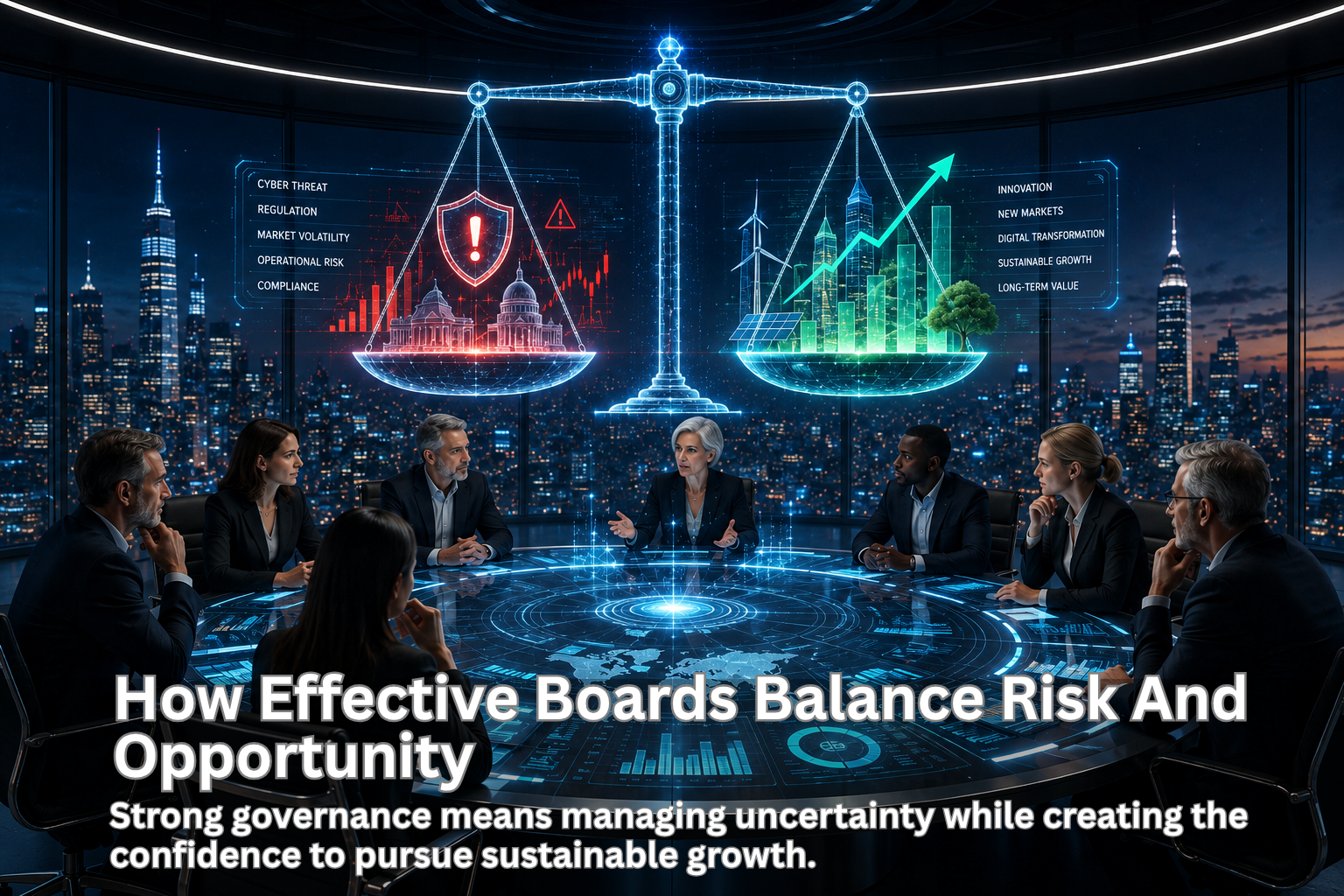
In today’s fast-changing business environment, boards face a constant challenge: how do you protect the organisation from unnecessary risk while still taking advantage of opportunities for growth?
Effective governance is not about avoiding risk altogether. It is about understanding risk, challenging assumptions and making informed decisions that support long-term success. 📈
⚖️ Risk Management Is Not About Avoiding Risk
Every organisation faces risk. The key is understanding which risks are worth taking and which could threaten the organisation’s long-term resilience.
Effective boards ask important questions such as:
- 🔍 What are the key risks facing the organisation?
- 💡 What opportunities could come from taking calculated risks?
- 📊 Do we have enough information to make an informed decision?
- 🛡️ What controls are needed to manage potential downside?
- 🎯 Does the level of risk align with our overall strategy?
The objective is not to eliminate uncertainty, but to make sure the organisation takes calculated and strategic risks.
🧠 Creating Constructive Challenge
A strong boardroom should encourage healthy debate.
Non-executive directors should feel confident challenging management, testing assumptions and asking difficult questions, while maintaining a constructive and collaborative relationship.
Good boardroom challenge can include:
- ❓ Asking “What if our assumptions are wrong?”
- 🔄 Considering alternative strategies.
- 📉 Exploring potential downside scenarios.
- 📈 Identifying opportunities that may have been overlooked.
- 🤝 Encouraging open and honest discussion.
The best boards combine challenge with support, helping management make better decisions without creating unnecessary barriers to progress.
🎯 Connecting Risk With Strategy
Risk should not be considered separately from business strategy.
Whenever a board considers a major strategic decision, it should look at both the potential rewards and the risks involved.
For example, entering a new market may involve:
- 🌍 Regulatory uncertainty.
- 💷 Significant investment.
- ⚙️ Operational challenges.
- 👥 New customer expectations.
- 🏆 Increased competitive pressure.
However, choosing not to enter the market could also create risk if competitors gain an advantage.
Effective boards therefore consider both the risk of action and the risk of inaction.
🌱 Building a Healthy Risk Culture
Boards play an important role in shaping organisational culture.
A strong risk culture encourages employees and leaders to identify concerns early, learn from mistakes and make decisions based on evidence.
Key characteristics include:
- 🚨 Raising concerns early.
- 💬 Encouraging open communication.
- 📚 Learning from mistakes.
- 📊 Using reliable information when making decisions.
- 🔎 Monitoring emerging risks.
- 💡 Encouraging responsible innovation.
A strong culture does not prevent people from taking risks. Instead, it helps ensure that risks are understood, managed and aligned with the organisation’s objectives.
🔮 Preparing for the Unexpected
No board can predict every challenge.
Economic uncertainty, technological change, geopolitical developments, regulatory changes and evolving customer expectations can all affect an organisation.
Scenario planning and stress testing can help boards consider different possibilities.
Boards can ask:
- 🔮 What could happen if conditions change?
- 🛡️ How resilient is the organisation?
- 🔄 How quickly could we respond?
- 📋 Do we have appropriate contingency plans?
The goal is not to predict the future perfectly. It is to ensure the organisation is prepared to respond effectively when circumstances change.
👥 The Value of Experienced Non-Executive Directors
Non-executive directors can bring valuable independence, experience and external perspective to the boardroom.
Their role is not simply to identify problems. They can also help organisations:
- 💡 Identify new opportunities.
- 🧠 Challenge established thinking.
- 🎯 Strengthen strategic decision-making.
- 🔍 Identify blind spots.
- 🤝 Provide independent perspective.
- 📈 Support sustainable growth.
A diverse board with the right mix of skills and experience can provide stronger challenge and better decision-making.
🚀 Finding the Right Balance
Ultimately, effective boards are not defined by how little risk they take.
They are defined by how intelligently they make decisions when faced with uncertainty.
The right balance requires:
- ⚖️ Strong governance.
- 🎯 Clear strategic priorities.
- 🧠 Constructive boardroom challenge.
- 📊 High-quality information.
- 🛡️ Effective risk oversight.
- 💡 A willingness to embrace well-considered opportunities.
🌟 The Wyman Bain Perspective
At Wyman Bain, we recognise that strong leadership and effective governance are fundamental to organisational success.
The right board brings together the experience, independence and perspective needed to challenge constructively, manage risk and identify opportunities for sustainable growth.
The most effective boards do not simply protect the organisation from what could go wrong , they help leadership recognise what could go right. 🚀