
Why Succession Plans Fail When They’re Needed Most ⚠️
Why Succession Plans Fail When They’re Needed Most ⚠️
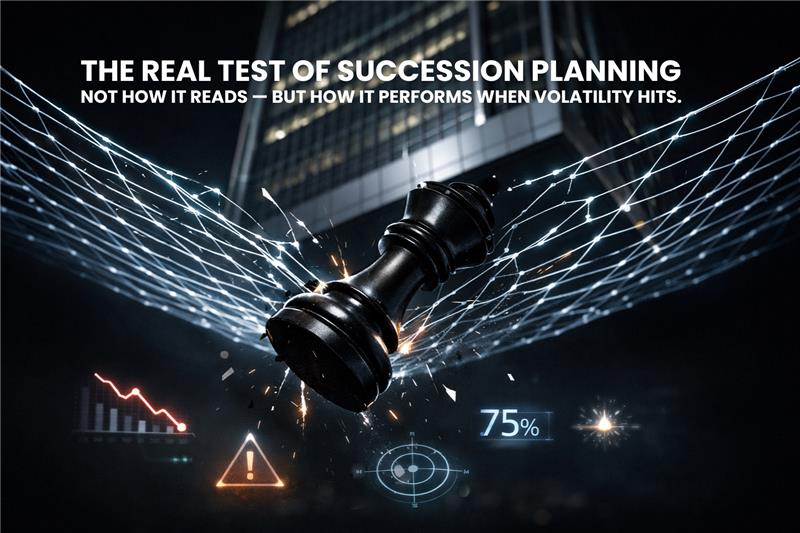
Succession planning exists to protect
organisations at moments of maximum risk.
Yet time and again, it is precisely during those moments, sudden
executive departures, crises or market disruption, that succession plans fall short.
The issue is rarely the absence of a plan.
It is that the plan was never designed for the conditions in which it is ultimately tested.
For boards, understanding why succession plans fail under pressure is essential to safeguarding continuity, confidence and long-term value creation.
The False Comfort of Formal Plans 🗂️
Many organisations appear well prepared.
They have:
- Named successors
- Documented emergency processes
- Annual succession reviews
However, when a transition is triggered, boards often discover that the plan provides little practical support.
This is because succession planning is frequently treated as a governance requirement rather than a strategic risk discipline. The focus is placed on coverage rather than capability, and on process rather than readiness.
A plan can be complete and still be ineffective.
Succession Built for
Stability, Tested in Volatility 🔍
Most
succession plans are developed during periods of relative stability.
They are activated in conditions of uncertainty.
When the environment changes, the leadership profile required changes with it.
A successor suited to steady growth may be ill-equipped for crisis.
A leader capable of transformation may struggle with stabilisation.
The failure is not one of talent.
It is a failure to account for
context.
The
Limitations of “Ready Now” Labels ⏱️
Succession planning often relies on simplified readiness classifications: ready now, ready soon, ready later.
These labels rarely examine:
- Decision-making under sustained pressure
- Behavioural consistency in ambiguity
- Judgement across short and long time horizons
As a result, boards discover too late that “ready now” does not mean ready for this situation.
Static Plans in Dynamic
Conditions 🧠
Leadership risk evolves continuously, but succession plans are often reviewed only annually.
This creates a dangerous gap between the assumptions within the plan and the reality facing the organisation.
When succession is triggered unexpectedly, boards are forced to make high-stakes decisions using outdated data, compressed timelines and limited evidence, precisely when judgement matters most.
Governance Ambiguity and Shared Assumptions 🤝
Succession plans fail most often where accountability is unclear.
Boards may assume readiness has been validated.
Executives may assume development is ongoing.
HR may assume alignment exists.
Without explicit challenge, ownership and governance oversight, succession planning becomes passive, until it is urgently required.
What Effective Succession Planning Requires
High-performing boards treat succession planning as a continuous, evidence-led discipline.
They:
- Define succession against plausible future scenarios, not historic success
- Distinguish between crisis, transitional and sustainable leadership needs
- Assess judgement, not just experience or tenure
- Re-test assumptions as conditions change
- Retain board-level ownership of leadership risk
Effective succession planning does not attempt to predict the future.
It prepares the organisation to respond when the future is uncertain.
The
Wyman Bain Perspective 🔍
At Wyman Bain, we help boards move beyond theoretical succession planning to decisions grounded in reality.
We work with clients to:
- Clarify what leadership is required now and next
- Assess successor readiness under pressure and over time
- Identify latent risks within existing succession plans
- Strengthen board confidence during moments of transition
Because the true measure of a succession plan is not how well it reads in stable conditions, but how reliably it performs when stability disappears.
📩 To discuss succession planning, leadership assessment or board advisory support, the Wyman Bain team would be pleased to help.
CONTACT US >>>>>>>>>>>