
Executive Search in Times of Organisational Stress 🔍
Executive Search in Times of Organisational Stress 🔍
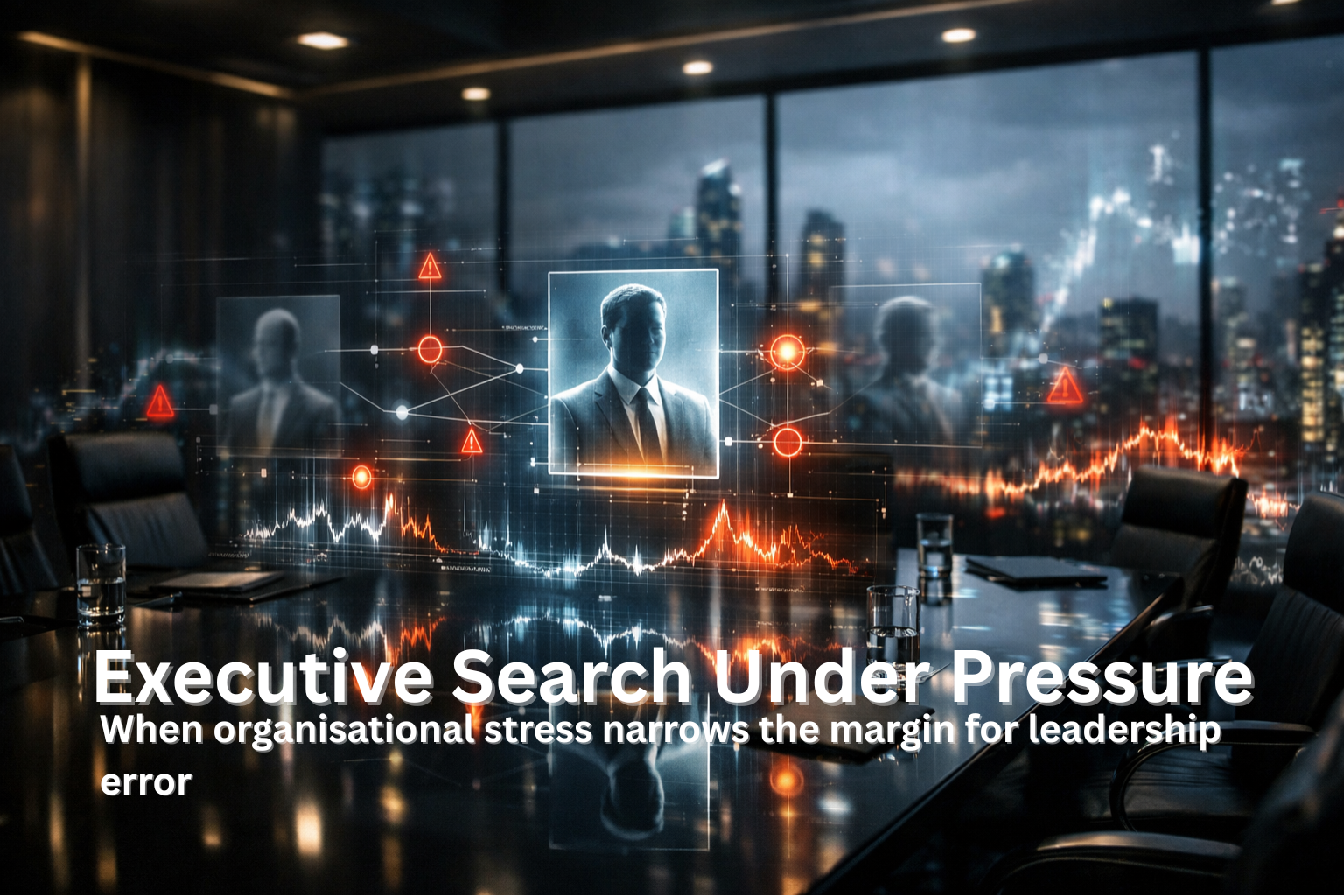
Periods of organisational stress expose leadership risk with exceptional clarity.
Sudden
executive departures, market disruption, regulatory pressure or deteriorating performance fundamentally alter what organisations require from their leaders and by extension, how executive search must be conducted.
In these
conditions, the margin for error narrows significantly. Appointments made under stress carry heightened consequences for organisational stability, stakeholder confidence and long-term value creation.
Why conventional executive search approaches fall short 🧠
Many executive search processes are designed for stable environments.
They assume time, optionality and incremental change.
Organisational stress removes all three.
Boards are often required to appoint at pace, under intense scrutiny, and with limited tolerance for misjudgement. In such circumstances, traditional indicators of suitability, sector experience, prior role scale or reputational success, can provide false assurance.
What matters most is not historical performance, but the ability to lead effectively in the current and emerging context.
Stress redefines leadership requirements 🔍
Periods of stress materially change the leadership profile required:
• Accelerated
decision-making with incomplete or evolving information
• Judgement across immediate stabilisation and longer-term recovery
• The ability to maintain stakeholder confidence under pressure
• Behavioural consistency and resilience in ambiguity
A leader effective in growth may struggle in crisis.
A transformation specialist may destabilise an organisation that first requires control and credibility.
Effective executive search recognises that context, not capability alone, determines leadership effectiveness.
The risks of urgency-driven appointments ⏱️
Urgency increases exposure.
Under pressure, organisations may default to familiar profiles, known networks or “safe pair of hands” assumptions. These shortcuts can unintentionally amplify risk.
Without rigorous assessment of judgement, adaptability and behaviour under sustained pressure, boards may appoint candidates who appear credible on paper but are ill-suited to the realities they will face.
Speed is important. Evidence is essential.
What effective executive search requires under pressure ✅
High-performing boards treat executive search in times of stress as a strategic risk discipline. This involves:
• Defining leadership requirements against present and near-term realities
• Testing judgement, not solely experience or tenure
• Assessing performance under sustained pressure and uncertainty
• Distinguishing between stabilisation, transition and long-term leadership needs
• Retaining clear board-level ownership of appointment decisions
The objective is not simply to fill a vacancy, but to safeguard organisational resilience.
The Wyman Bain approach 🔍
At Wyman Bain, we support boards and investors navigating executive appointments in complex, high-pressure environments.
Our work focuses on:
• Clarifying what leadership is required now and next
• Assessing judgement,
adaptability and behaviour under pressure
• Identifying latent risks overlooked by traditional search processes
• Strengthening decision confidence when time and tolerance are constrained
Because in times of organisational stress, executive search is not about identifying the best leader in theory, it is about appointing the right leader for the reality the organisation faces.
📩 To discuss executive search, leadership assessment or board advisory support, the Wyman Bain team would be pleased to help.
CONTACT US >>>>>>>>>>