
Why Investors Should Prioritise Leadership Assessment 📈👔
Why Investors Should Prioritise Leadership Assessment 📈👔
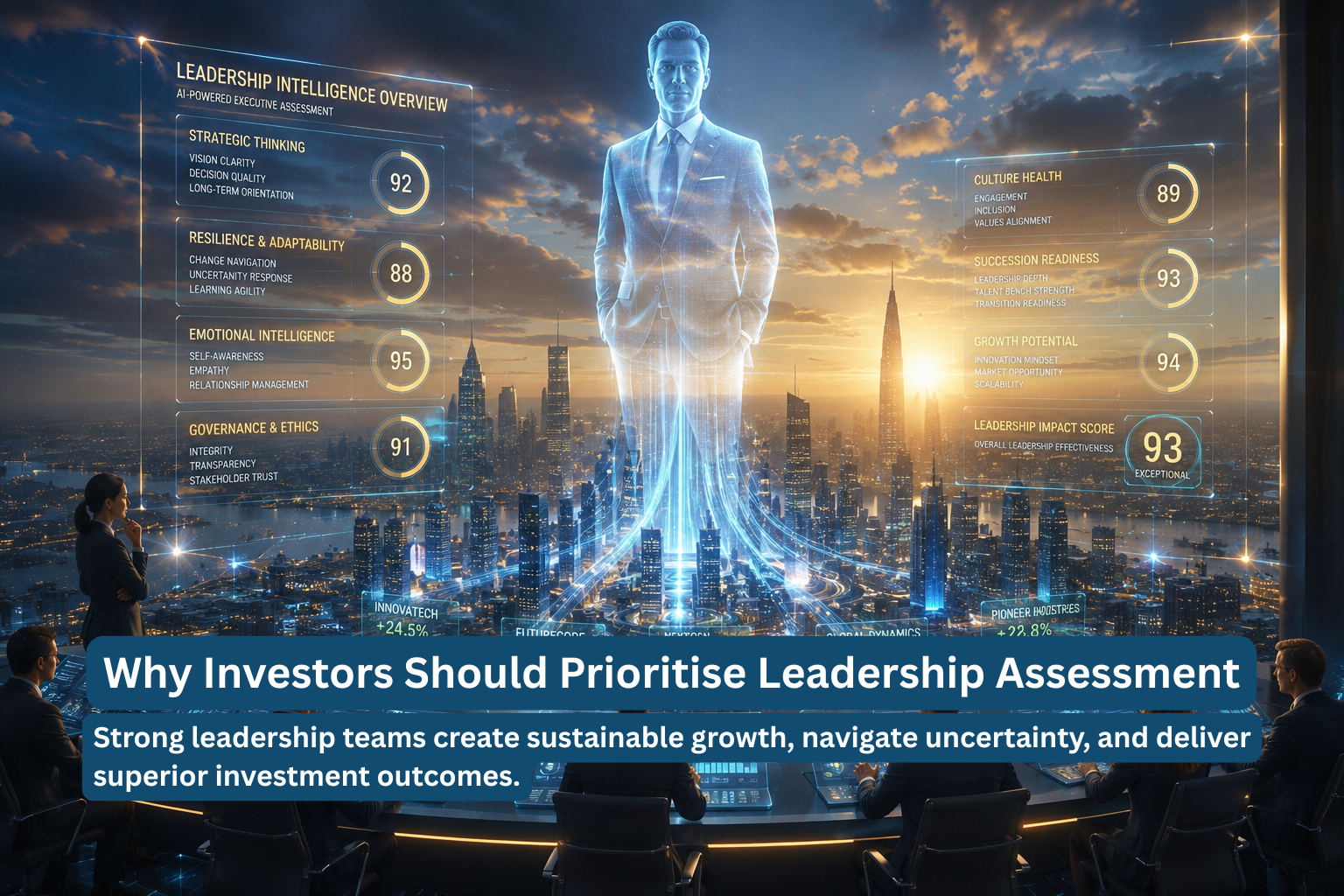
When evaluating an investment opportunity, financial performance, market potential, and competitive advantage often dominate the due diligence process. However, one critical factor is frequently underestimated: leadership quality.
The reality is simple: even the strongest business model can fail under poor leadership, while exceptional leaders can navigate challenges, adapt to change, and unlock significant value. For investors seeking sustainable returns, assessing leadership capability should be a core part of every investment decision.
Leadership Drives Business Performance 🚀
A company's success is heavily influenced by the decisions made by its leadership team. Strategic direction, organisational culture, talent retention, operational execution, and stakeholder management all stem from leadership effectiveness.
Strong leaders:
✅ Create and communicate a compelling vision
✅ Build high-performing teams
✅ Make informed decisions under pressure
✅ Adapt quickly to changing market conditions
✅ Foster innovation and accountability
Conversely, weak leadership can lead to poor execution, low employee engagement, reputational damage, and ultimately, reduced shareholder value.
Financial Results Tell You What Happened, Leadership Assessment Helps Predict What Happens Next 🔮
Historical financial performance provides valuable insights into a company's past. However, investors are primarily interested in future growth and returns.
Leadership assessment offers a forward-looking perspective by evaluating factors such as:
- Strategic thinking
- Decision-making capability
- Emotional intelligence
- Resilience
- Adaptability
- Risk management
- Team leadership
Understanding these attributes helps investors determine whether a leadership team can successfully deliver future objectives and navigate uncertainty.
Leadership Risk Is Investment Risk ⚠️
Many investment failures can be traced back to leadership shortcomings rather than flaws in the business itself.
Common leadership risks include:
🔴 Lack of strategic clarity
🔴 Poor succession planning
🔴 Inability to scale operations
🔴 Weak governance practices
🔴 Resistance to change
🔴 Cultural misalignment
Identifying these risks early enables investors to make more informed decisions and implement mitigation strategies before problems arise.
The Importance of Leadership Assessment During Due Diligence 🔍
Traditional due diligence focuses on financial, legal, and operational factors. While essential, these areas often overlook the human element that drives organisational performance.
A comprehensive leadership assessment can provide insights into:
Leadership Capability
Can the leadership team execute the growth strategy effectively?
Team Dynamics
Do senior leaders collaborate productively and align around common goals?
Organisational Culture
Is the culture likely to support growth, innovation, and long-term success?
Succession Readiness
Is the business overly dependent on one individual, or is there leadership depth across the organisation?
These insights help investors understand not only whether a company can succeed, but also how likely it is to achieve its ambitions.
Private Equity and Leadership Value Creation 💼
Private equity firms increasingly recognise that leadership quality is a major driver of value creation.
Research consistently shows that portfolio companies with strong leadership teams are more likely to:
📈 Achieve growth targets
📈 Execute transformation initiatives successfully
📈 Retain key talent
📈 Improve operational performance
📈 Deliver stronger exit outcomes
As a result, leadership assessment is becoming an integral component of both pre-acquisition due diligence and post-investment value creation programmes.
Leadership Assessment Supports Better Investment Decisions 🎯
Investors who prioritise leadership assessment gain a more complete understanding of an organisation's strengths, risks, and growth potential.
Benefits include:
✔️ Improved investment selection
✔️ Reduced leadership-related risk
✔️ Enhanced portfolio performance
✔️ Better succession planning visibility
✔️ Increased confidence in management teams
✔️ Stronger long-term value creation
By combining financial analysis with robust leadership evaluation, investors can make more informed decisions and improve the probability of achieving successful investment outcomes.
Final Thoughts 💡
In today's increasingly complex and competitive business environment, leadership quality is one of the most important predictors of organisational success. While financial metrics remain essential, they only tell part of the story. Assessing the capabilities, behaviours, and potential of leadership teams provides investors with critical insights that numbers alone cannot reveal.
For investors seeking sustainable growth and long-term value creation, leadership assessment should not be viewed as an optional exercise, it should be a strategic priority.
About Wyman Bain 🤝
At Wyman Bain, we help investors, boards, and business leaders make better decisions through expert leadership assessment, executive evaluation, and organisational consulting. Our evidence-based approach provides the insight needed to identify leadership strengths, mitigate risk, and support sustainable business growth.
Want to learn how leadership assessment can strengthen your investment strategy? Contact Wyman Bain today to start the conversation. 📩📊