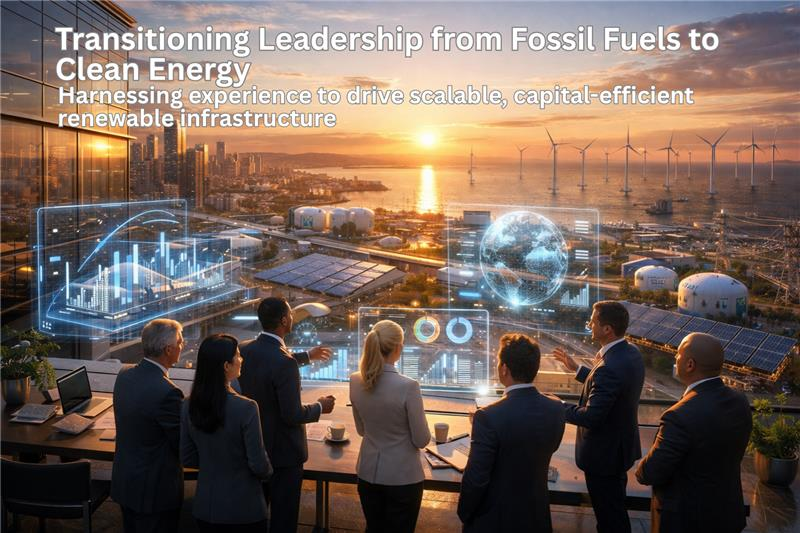
🔄 Transitioning Leaders from Fossil Fuel Backgrounds into Clean Energy Roles ⚡
🔄 Transitioning Leaders from Fossil Fuel Backgrounds into Clean Energy Roles ⚡
The global
energy transition is no longer theoretical, it is capitalised, regulated and accelerating. As investment flows shift towards renewables, storage, hydrogen and grid infrastructure, demand for experienced, commercially disciplined leadership is intensifying.
Contrary to common perception, many of the leaders best equipped to scale clean energy platforms are emerging from oil, gas and conventional power backgrounds.
At
Wyman Bain, we advise boards, investors and senior
executives on repositioning leadership capability for the energy transition, ensuring experience translates into future-facing impact.
🌍 The Strategic
Context
Clean energy growth is infrastructure-heavy, capital-intensive and politically exposed. It demands:
- Sophisticated capital allocation 💷
- Major project governance 🏗️
- Regulatory fluency 📜
- Stakeholder management at scale 🤝
- Operational risk discipline ⚖️
These are not new disciplines. They are hallmarks of traditional energy leadership.
The transition challenge is therefore not capability, it is strategic reframing and market alignment.
⚡ Reframing Experience for a
Decarbonised Future
Leaders moving from hydrocarbons to renewables must articulate their track record through a transition lens.
Where the past emphasised:
- Production growth and reserve replacement
The future emphasises:
- Capital-efficient infrastructure delivery aligned with decarbonisation pathways
Where experience centred on:
- Asset optimisation in mature basins
The narrative now becomes:
- Lifecycle performance, emissions reduction and sustainable value creation
Clean energy investors are not seeking ideological purity, they are seeking execution credibility.
🧠 Transferable Leadership Strengths
Successful transitions typically draw on:
1️Capital Discipline & Portfolio Strategy
Subsidy frameworks, merchant exposure and evolving policy landscapes require robust investment governance.
2️Megaproject Delivery Capability
Offshore wind, interconnectors and hydrogen clusters demand experienced oversight.
3️Regulatory & Government Engagement
Energy remains politically sensitive; seasoned stakeholder navigation is critical.
4️Safety, Compliance & ESG Governance
Strong operational cultures underpin scalable renewable platforms.
In short, the energy transition does not remove complexity, it redistributes it.
🚧 Perception Barriers to Overcome
Despite strong alignment, leaders often face:
- Assumptions about legacy industry mindset
- Limited exposure to renewable-specific financing mechanisms
- Networks anchored in traditional energy markets
- Underdeveloped personal decarbonisation narratives
These barriers are reputational rather than structural and can be addressed with deliberate positioning.
🎯 Accelerating the
Transition
Leaders seeking to reposition effectively should:
- Build literacy in renewable project finance and policy mechanisms
- Develop visible ESG leadership credentials 🌱
- Expand networks across infrastructure funds and climate investors
- Secure advisory or board exposure within clean technology ventures
- Articulate a credible personal commitment to the transition
This is not about distancing from the past. It is about aligning experience with the future.
🏢
The Board & Investor Perspective
Boards and infrastructure investors prioritise:
- Scalable growth with capital discipline 📈
- Governance maturity
- Credibility with regulators and stakeholders
- Long-term value protection alongside expansion
Leaders who combine operational realism with strategic clarity are particularly compelling.
Execution matters more than rhetoric.
🤝 How
Wyman Bain Supports Energy Transition Leadership
We partner with:
- Senior executives repositioning into clean energy platforms
- Boards managing succession amid transition
- Infrastructure and climate investors assessing executive capability
Our advisory includes:
- Strategic narrative development
- Leadership capability benchmarking
- Market positioning and opportunity mapping
- Board-level succession planning aligned to transition strategy
🚀 A Structural Leadership Shift
The movement of experienced leaders from fossil fuels into clean energy represents one of the most significant redeployments of industrial leadership in decades.
Organisations that harness this experience gain:
- Delivery certainty
- Capital credibility
- Governance robustness
- Operational resilience
The energy transition requires ambition, but it also requires discipline.
The question is not whether fossil fuel leaders can succeed in clean energy.
It is whether organisations are prepared to recognise and position that capability effectively.
CONTACT US >>>>>>>>>