
Red Flags Boards Should Never Ignore During Executive Interviews 🚩
Red Flags Boards Should Never Ignore During Executive Interviews 🚩
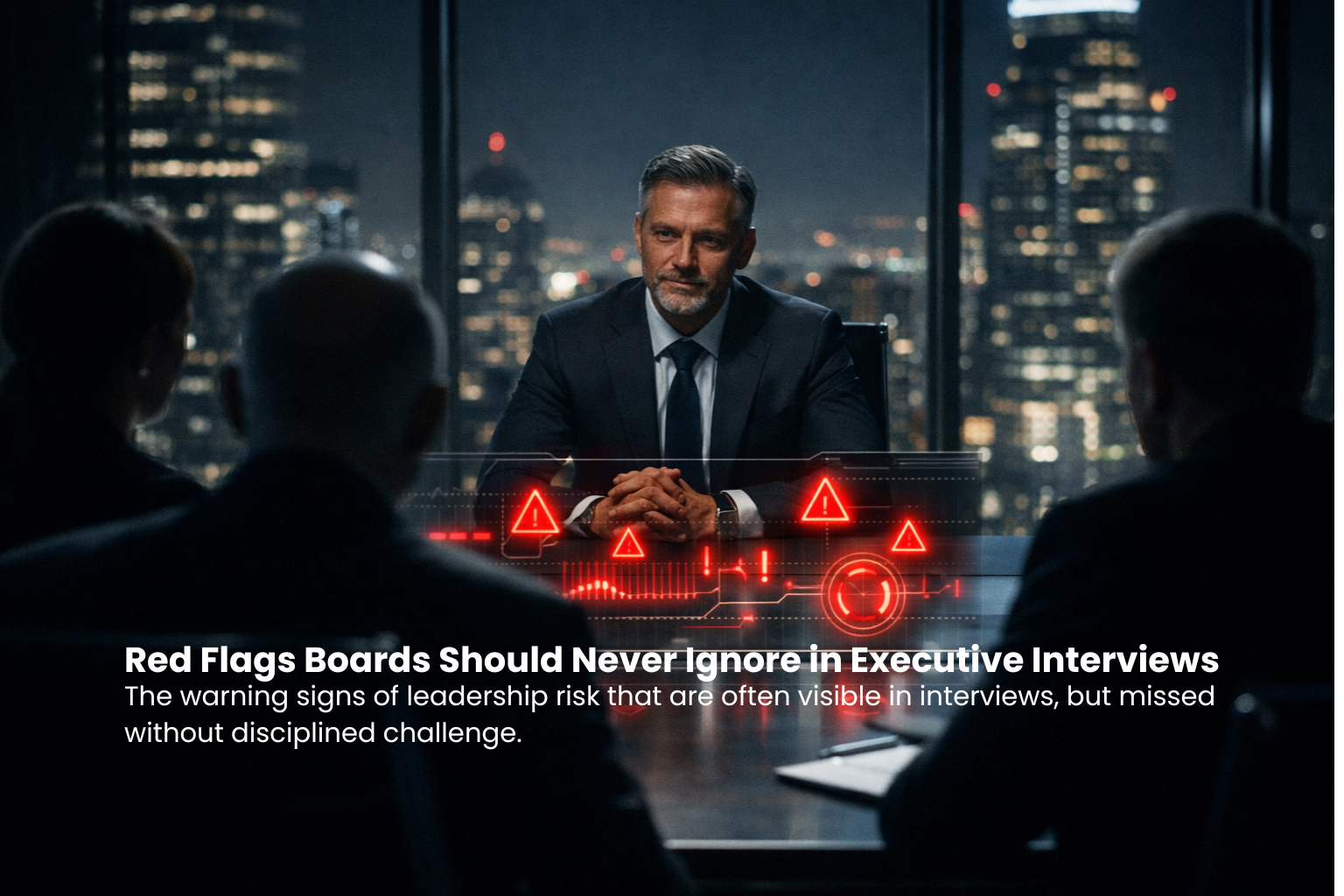
Executive interviews are not simply an evaluation of experience or capability.
They are a critical governance exercise, one that determines whether leadership risk is being mitigated or unknowingly introduced.
While most boards focus on track record, presence and technical competence,
executive appointments most often fail for reasons that were visible during the interview process but insufficiently tested at the time.
At
Wyman Bain, we consistently observe that unsuccessful appointments are preceded by identifiable warning signs. The challenge is rarely recognising red flags, it is having the discipline to interrogate and act on them.
Below are the red flags boards should never ignore.
🎯 Lack of
Strategic Clarity
Senior executives should demonstrate clear, coherent thinking, even in complex or ambiguous environments.
Red flags include:
- Vague or overly generic strategic responses
- Heavy reliance on language without substance
- Inability to articulate priorities or trade-offs
- Inconsistent strategic narratives across interviews
Strategic ambiguity often signals either limited depth or an avoidance of accountability. Boards should expect leaders to clarify complexity, not obscure it.
🧠 Avoidance of
Accountability
How candidates describe past challenges is one of the most reliable indicators of future behaviour.
Warning signs include:
- Repeated attribution of failure to others or external factors
- Limited ownership of outcomes
- A narrative that frames success as circumstantial rather than deliberate
High-calibre leaders acknowledge mistakes, demonstrate learning and show growth. Persistent deflection is a strong predictor of future blame-shifting.
⚠️ Discomfort with
Challenge
Executive interviews should be rigorous by design. How candidates respond under scrutiny matters.
Red flags include:
- Defensiveness or irritation when challenged
- Evasion of difficult questions
- Attempts to dominate or control the discussion
- Discomfort with alternative viewpoints
Leaders who resist challenge in interviews are unlikely to welcome
constructive tension in the boardroom.
🧩 Misalignment Between Stated
Values and Behaviour
Culture is not defined by intent; it is revealed through behaviour.
Boards should be alert where:
- Values are articulated fluently but not evidenced
- Leadership examples contradict stated principles
- There is inconsistency between words and actions
Where lived behaviour diverges from
cultural messaging, trust erodes quickly, and is rarely rebuilt.
💼 Disproportionate Focus on Authority Over Impact
At senior levels, motivation should be anchored in impact, stewardship and outcomes.
Red flags include:
- Early fixation on reporting lines, titles or control
- Emphasis on authority rather than accountability
- Limited curiosity about organisational context or constraints
Executives who prioritise position over purpose often struggle to lead through influence.
🤝 Limited Stakeholder Awareness
Senior leaders operate within complex ecosystems of boards, investors, peers and teams.
Warning signs include:
- Simplistic views of stakeholder dynamics
- Limited appreciation of board or investor expectations
- Insufficient curiosity about governance and alignment
Poor stakeholder judgement is one of the most common causes of
executive derailment.
🚨 The Cost of Ignoring Red Flags
When boards rationalise or overlook early warning signs, the consequences are often significant:
- Loss of organisational momentum and confidence
- Cultural disruption and leadership friction
- Increased pressure on incumbent teams
- Costly and urgent leadership transitions
These costs are rarely visible on a balance sheet, but they are strategically material.
🤝 The
Wyman Bain Perspective
At Wyman Bain, we believe executive interviews should be designed to surface risk, not simply confirm competence.
We support boards and investors by:
- Stress-testing leadership judgement and mandate
- Assessing decision-making quality under pressure
- Evaluating cultural reality, not just cultural fit
- Identifying misalignment early in the process
The most successful appointments are those where potential risks are addressed openly, not discovered after appointment.
💡
Final Thought
Red flags rarely present as obvious failures.
More often, they appear as subtle signals that are explained away in the momentum of a search.
Boards that consistently appoint exceptional leaders are those willing to pause, probe and challenge, even when a candidate looks compelling on paper.
📩 To discuss executive search, leadership assessment or board advisory support, please contact the Wyman Bain team.