
Why High-Calibre Executives Walk Away Late in the Search Process
Why High-Calibre Executives Walk Away Late in the Search Process
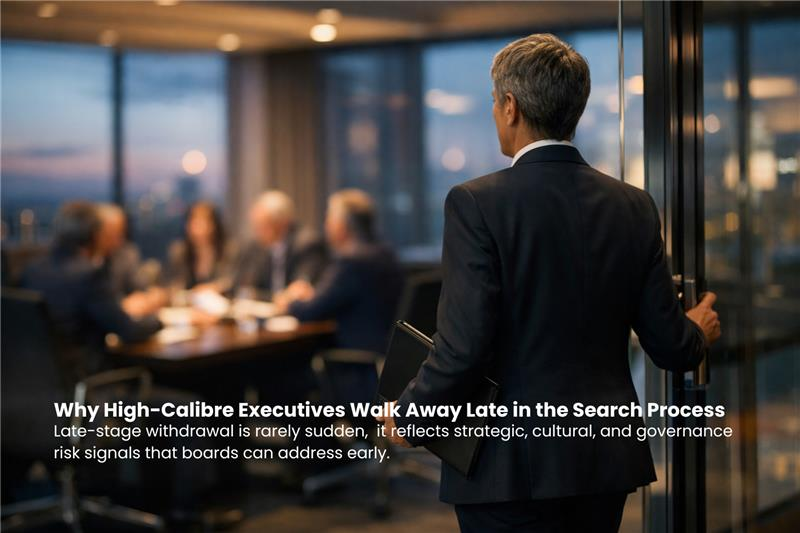
Late-stage withdrawal by senior executive candidates is one of the most costly and disruptive outcomes in an
executive search. By the time a process reaches its final stages, significant time, credibility and organisational attention have already been invested by boards, investors and candidates alike.
When high-calibre executives disengage at this point, it is rarely impulsive. More often, it reflects considered judgement that the
risk profile of the role, or the organisation’s readiness to support success, is higher than initially presented.
At
Wyman Bain, we observe that late-stage attrition is typically driven by identifiable and preventable factors.
Strategic
Ambiguity Becomes Apparent 🎯
Senior executives do not commit to roles in isolation; they commit to strategies.
While early conversations may appear aligned, deeper engagement often surfaces unresolved questions:
- Is there genuine consensus at board and investor level?
- Are strategic priorities clearly defined and stable?
- Is the mandate for change explicit and supported?
Where strategy appears fluid, contradictory or politically constrained, experienced leaders recognise that delivery risk is being transferred to them personally.
Decision-Making
Quality Signals Risk 🧠
High-calibre executives evaluate governance and decision quality as rigorously as capability and culture.
Late-stage interactions frequently reveal:
- Inconsistent messaging from key stakeholders
- Protracted or opaque decision processes
- Reluctance to address difficult trade-offs
For senior leaders, how decisions are made is a strong indicator of future operating reality. Weak decision discipline is a common reason candidates reassess their commitment.
Role Scope Expands Without
Recalibration ⚠️
It is not uncommon for roles to evolve during a search. However, risk emerges when expectations change without transparency or recalibration.
This typically includes:
- Expanded accountability without corresponding authority
- Increased delivery risk without additional support
- Shifting success criteria late in the process
High-calibre executives are alert to imbalances in risk, influence and mandate.
Cultural Reality Overrides
Cultural Narrative 🧩
Culture is revealed through behaviour, not messaging.
As candidates engage more deeply, they observe:
- How challenge is received
- How disagreement is managed
- How power and influence are exercised
Where lived culture diverges from stated values, trust erodes quickly. Once credibility is compromised, it is rarely recovered.
Misalignment on Impact, Not Remuneration 💼
Contrary to common assumption, late-stage withdrawal is rarely driven primarily by compensation.
More frequently, candidates question:
- Their ability to influence outcomes
- The clarity and durability of their mandate
- The level of stakeholder alignment and sponsorship
For senior leaders, impact, credibility and legacy outweigh
financial considerations.
The
Organisational Cost of Late-Stage Withdrawal
When executive candidates disengage late in a process, consequences often include:
- Loss of momentum and internal confidence
- Reputational impact in the leadership market
- Increased pressure on incumbent teams
- Restarting the search under greater urgency
These costs are seldom visible on a balance sheet but are strategically material.
How Boards Reduce Late-Stage Attrition 🤝
Boards and investors that consistently secure high-calibre leaders:
- Establish and align around strategy and mandate early
- Demonstrate disciplined, timely and transparent decision-making
- Test cultural reality, not just cultural fit
- Address risk openly and constructively
- Engage candidates as future partners, not applicants
Clarity, consistency and credibility are the strongest predictors of successful executive appointments.
The
Wyman Bain Perspective
At Wyman Bain, our work extends beyond identifying exceptional leaders. We support boards and investors in ensuring organisational readiness to appoint them.
Our approach focuses on:
- Stress-testing leadership mandates
- Surfacing misalignment early in the process
- Assessing decision-making quality and governance
- Reducing late-stage risk for all stakeholders
The most successful executive appointments are those where both organisation and candidate proceed with confidence, not reservation.
Final Thought 💡
High-calibre executives rarely withdraw because of a single issue.
They step away when cumulative signals suggest that success would rely more on hope than on judgement.
📩 To discuss executive search, leadership assessment or board advisory support, please
contact the Wyman Bain team.