
Leadership Confidence vs Leadership Competence: Knowing the Difference 🧭
Leadership Confidence vs Leadership Competence: Knowing the Difference 🧭
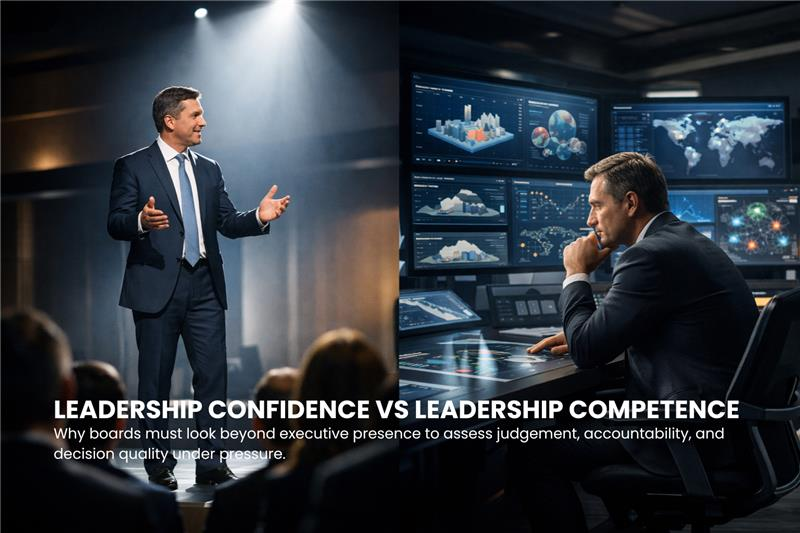
In senior leadership, confidence is often highly visible. Competence, by contrast, is revealed over time.
Boards and investors are frequently presented with leaders who communicate decisively, project certainty and appear comfortable under pressure. While these traits can be reassuring, confidence alone is not a reliable indicator of leadership effectiveness. Understanding the distinction between leadership confidence and leadership competence is essential to making sound executive and governance decisions.
At
Wyman Bain, we consistently observe that confusing confidence with competence is one of the most common and avoidable risks in senior leadership appointments.
Leadership Confidence:
Presence and Perception 💬
Leadership confidence relates to how a leader presents themselves and is perceived by others. It is often characterised by:
• Strong
executive presence and communication
• Decisiveness and assertiveness
• Comfort in high-stakes environments
• Willingness to take visible ownership
Confidence plays an important role in leadership. It can stabilise organisations during periods of uncertainty and create clarity for stakeholders. However, confidence is largely perceptual. It influences impression, not necessarily judgement or decision quality.
When not supported by capability and insight, confidence can obscure material risk.
Leadership Competence: Judgement and Capability 🧠
Leadership competence is grounded in substance rather than style. It is demonstrated through:
• Consistently sound
decision-making, particularly under pressure
• Effective balancing of short-term performance with long-term value
• Openness to challenge and evidence-based thinking
• Disciplined execution aligned with strategy and values
Competence may be less immediately visible than confidence, but it is far more predictive of sustainable performance and organisational resilience.
The Risk of Misjudgement ⚠️
Highly confident leaders can create strong early impressions, particularly in interviews, investor discussions and periods of disruption. Risk emerges when confidence exceeds competence.
Common warning signs include:
• Overconfidence in strategy or forecasts
• Limited tolerance for challenge or dissent
• Defensive responses to scrutiny
• Repeated errors in judgement during periods of change
These risks typically surface when conditions become more complex, precisely when strong leadership judgement is most critical.
Why Competence Builds Enduring
Trust 🌱
While confidence may inspire initial belief, competence earns long-term credibility. Investors and boards increasingly value leaders who:
• Demonstrate consistent judgement under uncertainty
• Learn from outcomes and adapt course when required
• Act with integrity and accountability
• Foster
cultures that encourage constructive challenge
This combination underpins trust, reduces risk and supports sustained value creation.
What Boards and
Investors Should Assess
Distinguishing confidence from competence requires looking beyond presentation to behaviour and decision-making patterns. Key assessment areas include:
• Track record of decisions and outcomes over time
• Behaviour under scrutiny and challenge
• Capacity for reflection, learning and adjustment
• Alignment between stated values and observed actions
Robust leadership assessment and rigorous referencing are essential in making this distinction.
The
Wyman Bain Perspective 🧭
At Wyman Bain, we support boards and investors by:
• Assessing executive judgement and behavioural alignment
• Stress-testing leadership capability under pressure
• Identifying confidence–competence gaps early
• Supporting well-governed
CEO and executive appointments
Because sustainable leadership is defined not by how confident it appears, but by the quality and consistency of judgement it delivers.
📩
To discuss executive search, leadership assessment or board advisory support, please
contact the Wyman Bain team.