Leadership Assessment: Beyond Competency-Based Interviews 🧠
Leadership Assessment: Beyond Competency-Based Interviews 🧠
In today’s business environment, leadership hiring has become far more complex than simply matching experience to a job description.
Organisations are navigating rapid digital transformation, evolving workforce expectations, economic uncertainty and increasing operational pressure, all while trying to maintain growth, resilience and competitive advantage. 🌍
Yet many
businesses still rely heavily on traditional competency-based interviews when assessing senior leadership talent.
At Wyman Bain, we believe that approach alone is no longer enough.
Because leadership success is not determined only by what someone has achieved in the past.
It is determined by how effectively they can lead through what comes next. 🚀
Why
Traditional Interviews Are No Longer Enough ⚠️
Competency-based interviews remain an important part of the assessment process. They help organisations understand experience, technical capability and examples of previous performance.
However, modern leadership requires qualities that are often difficult to measure through rehearsed interview responses alone.
Many executives can communicate achievements confidently.
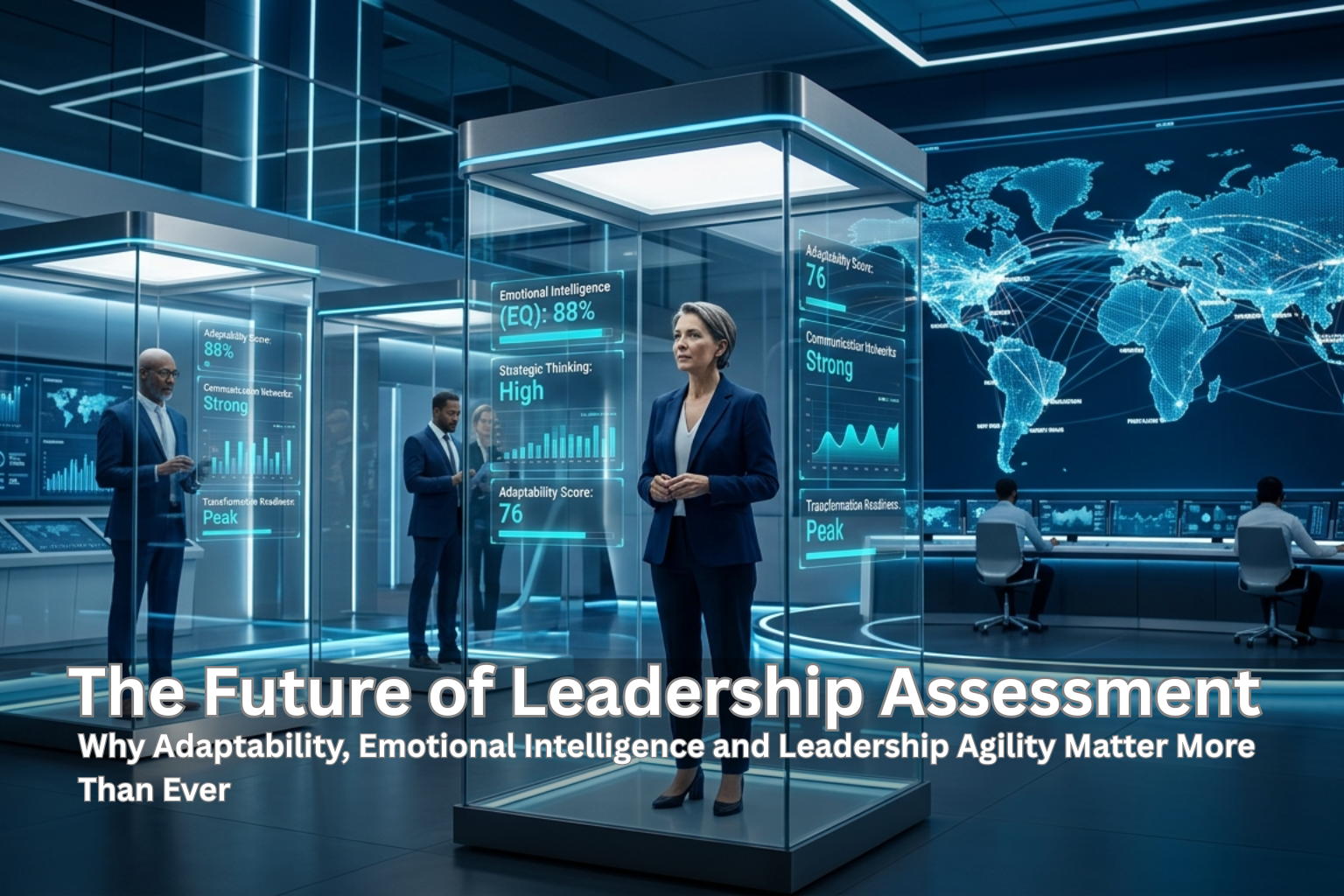
Far fewer can demonstrate the adaptability, emotional intelligence and leadership agility required to lead organisations through uncertainty, transformation and rapid change.
Traditional interviews often fail to fully assess:
🔄 Leadership adaptability under pressure
🤝 Emotional intelligence and self-awareness
📈
Strategic judgement in complex situations
🌱 Cultural and behavioural alignment
🚀 Transformation and change leadership capability
📊 Decision-making during uncertainty
💬 Communication and influence across diverse teams
In fast-changing environments, organisations need to assess not only experience, but how leaders think, behave and evolve. 🌱
Modern
Leadership Assessment Requires a Broader View 🌍
The strongest organisations no longer hire purely based on credentials or industry tenure.
They assess leadership capability holistically.
This means evaluating:
🧠 How leaders solve problems
🤝 How they influence people and
culture
📈 How they respond to uncertainty and pressure
🚀 How they drive transformation and performance
🌱 How they adapt as organisations evolve
Because leadership today is not about maintaining stability alone.
It is about creating clarity, resilience and direction during continuous change.
The Leadership Capabilities That Matter Most 🚀
Strategic Thinking 📊
Modern executives must balance long-term vision with operational execution.
Strong leaders connect strategy to measurable outcomes while remaining commercially aware and adaptable to shifting market conditions.
Leadership Agility 🔄
Business conditions can change rapidly.
The most effective leaders remain calm under pressure, make confident decisions with incomplete information and adapt quickly without losing strategic focus.
Leadership agility has become one of the strongest indicators of long-term
executive success.
Emotional Intelligence and Communication 🤝
Leadership is fundamentally human.
Executives who communicate clearly, build trust and create psychological safety consistently strengthen engagement, collaboration and organisational performance.
Technical expertise matters.
But communication and emotional intelligence often determine whether leadership influence succeeds or fails.
Cultural Alignment 🌱
Even highly experienced executives can struggle if their leadership style conflicts with organisational culture.
Modern leadership assessment must evaluate:
🤝 Values alignment
📢 Communication style
🌍
Leadership behaviour
🚀 Ability to strengthen culture during growth and transformation
Because culture is shaped by leadership behaviour every single day.
Why Leadership Potential Matters More Than Past
Success 🌟
One of the most common hiring mistakes organisations make is over-prioritising past achievements without assessing future leadership capability.
Previous success does not automatically guarantee future adaptability.
Today’s
executives are expected to lead through:
💻 Digital transformation
🤖 AI and automation
🌍 Global operational complexity
📈 Continuous organisational change
🤝 Hybrid workforce environments
⚖️ Increasing
stakeholder expectations
This requires leaders who can continuously learn, evolve and adapt alongside the business itself.
Because leadership capability is no longer static.
It must grow with the organisation.
The Cost of Poor Leadership
Assessment ⚠️
A poor executive appointment impacts far more than recruitment costs alone.
Leadership hiring mistakes often lead to:
📉 Reduced organisational performance
⚠️
Cultural disruption and disengagement
🔄 Increased turnover and instability
📊 Slower execution and
decision-making
🤝 Loss of trust across teams
💼 Long-term operational and commercial risk
The impact is rarely isolated to one role.
Leadership behaviour influences the entire organisation.
That is why leadership assessment should never be treated as a transactional hiring process.
It is a long-term business decision.
Building a More Effective Leadership Assessment Process 🧩
Forward-thinking organisations are moving beyond interview-only hiring models and adopting more comprehensive leadership assessment strategies.
This often includes:
🧠 Leadership behavioural assessment
📊 Strategic capability evaluation
🤝 Stakeholder and communication analysis
🚀 Leadership simulations and scenario testing
🌱 Cultural alignment assessment
📈
Succession and future leadership potential evaluation
The goal is not simply to identify who performed well previously.
It is to understand who can successfully lead the organisation into the future.
The
Wyman Bain Approach 🌍
At Wyman Bain, we partner with organisations to assess and build leadership capability aligned to long-term business performance, transformation and resilience.
Our work focuses on:
🎯
Executive search and leadership assessment
📈 Strategic and commercial capability evaluation
🤝 Organisational and cultural alignment
🌱 Succession planning and leadership pipeline development
🚀 Leadership agility and transformation readiness
🌍 Building leadership teams equipped for future complexity
We help organisations assess not only experience, but the leadership behaviours and capabilities required to sustain growth in rapidly evolving environments.
Conclusion 🚀
Leadership assessment is evolving because leadership itself is evolving.
Competency-based interviews alone are no longer enough to identify executives capable of navigating transformation, complexity and continuous change.
The organisations that build the strongest leadership teams are those assessing:
🌱 Adaptability
🤝 Emotional intelligence
📈
Strategic thinking
🚀 Leadership agility
🌍 Cultural alignment
Because ultimately, leadership success is not defined only by past achievements.
It is defined by the ability to lead confidently into the future.