🌍 How to Build Leadership Resilience in Times of Global Uncertainty
🌍 How to Build Leadership Resilience in Times of Global Uncertainty
In today’s rapidly evolving global landscape, uncertainty has become a constant. Economic volatility, geopolitical tensions, technological disruption and shifting workforce expectations are transforming how organisations operate.
For leaders, the
challenge is not simply managing change,
it is leading confidently through it.
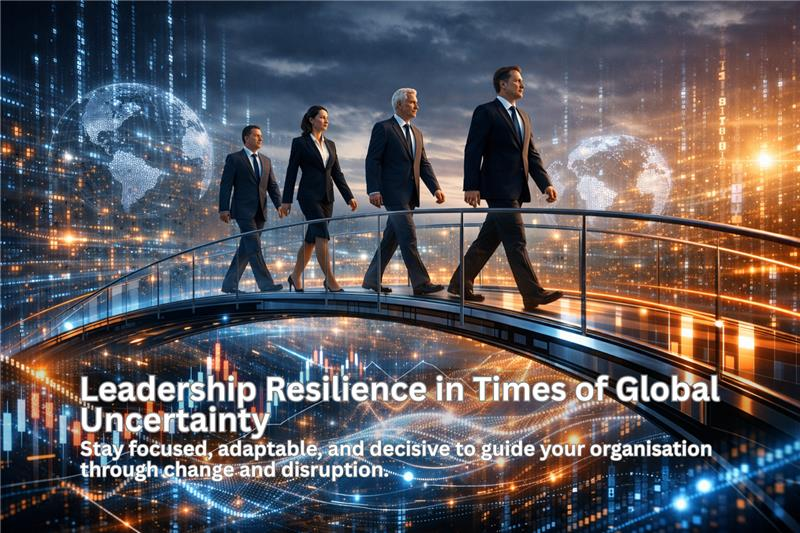
Leadership resilience is the ability to remain focused, adaptable and decisive in complex and unpredictable environments. Resilient leaders guide organisations through disruption while maintaining strategic clarity, organisational stability and stakeholder trust.
At
Wyman Bain, we believe resilient leadership is a defining capability for organisations seeking long-term success in uncertain times.
Below are key pillars for building leadership resilience.
🧠1.
Cultivate Strategic Foresight
Resilient leaders look beyond immediate challenges and maintain a clear view of long-term opportunities and risks.
Rather than reacting to every shift in the external environment, they assess trends, anticipate disruption and position their organisations for the future.
Organisations can strengthen strategic foresight by encouraging:
- Scenario planning and risk analysis
- Continuous monitoring of global and industry trends
- Strategic discussions that balance short-term priorities with long-term vision
Leaders with strong foresight enable organisations to remain
proactive, prepared and future-focused.
🔄2. Build Adaptability and Agility
In uncertain environments, rigid leadership approaches can quickly become ineffective.
Resilient leaders demonstrate flexibility. They adapt strategies, reassess priorities and respond quickly to evolving circumstances while maintaining organisational stability.
Organisations can foster adaptability by:
- Encouraging continuous learning and professional development
- Supporting innovation and experimentation
- Promoting cross-functional collaboration
Adaptable leadership ensures organisations remain
responsive, resilient and competitive.
💬3. Communicate with
Clarity and Transparency
During periods of uncertainty, communication becomes one of the most powerful leadership tools.
Employees, investors and stakeholders seek clarity, reassurance and direction. Leaders who communicate openly build trust and maintain alignment across the organisation.
Effective communication involves:
- Sharing information honestly and consistently
- Clearly explaining strategic priorities and decisions
- Encouraging feedback and open dialogue
Transparent communication strengthens
confidence, engagement and organisational cohesion.
🌱4. Invest in
Leadership Development
Resilience is developed over time through experience, learning and structured development.
Organisations that invest in leadership capability create a stronger pipeline of leaders prepared to navigate complexity and disruption.
Leadership development should focus on:
- Strategic thinking and decision-making
- Emotional intelligence and stakeholder management
- Crisis leadership and risk awareness
Developing leadership talent at every level strengthens
long-term organisational resilience.
🤝5. Foster a
Culture of Trust and Collaboration
Resilient organisations are built on strong relationships and shared purpose.
Leaders who encourage collaboration, openness and inclusivity create environments where teams can respond effectively to challenges and uncertainty.
To strengthen this culture, organisations should:
- Encourage knowledge sharing and teamwork
- Recognise contributions and achievements
- Promote inclusive leadership and diverse perspectives
A culture of trust enables organisations to
adapt collectively and maintain performance under pressure.
⚖️6. Uphold Integrity and
Accountability
In times of uncertainty, ethical leadership and strong governance become even more important.
Resilient leaders remain committed to organisational values while balancing immediate pressures with long-term responsibilities.
They demonstrate:
- Integrity in decision-making
- Transparency with stakeholders
- Accountability for organisational outcomes
Maintaining these principles safeguards
credibility, trust and reputation.
🚀Turning Uncertainty into
Opportunity
Global uncertainty will continue to shape the future of business. Organisations that cultivate resilient leaders are better positioned not only to withstand disruption but also to identify opportunities within it.
Resilient leadership enables organisations to:
- Navigate complex challenges with confidence
- Maintain strategic focus during volatility
- Strengthen stakeholder trust
- Drive sustainable growth in uncertain conditions
In an unpredictable world,
leadership resilience is a critical competitive advantage.
🤝How
Wyman Bain Supports Organisations
At
Wyman Bain, we partner with boards and organisations to identify, assess and develop leaders capable of navigating complex global challenges.
Through our executive search, leadership advisory and talent assessment expertise, we help organisations build leadership teams with the vision, resilience and capability required to succeed in an ever-changing world.
Because in times of global uncertainty, resilient leadership is the foundation of long-term organisational success.