🧠 Decision-Making Biases Boards Must Address in Executive Search
🧠 Decision-Making Biases Boards Must Address in Executive Search
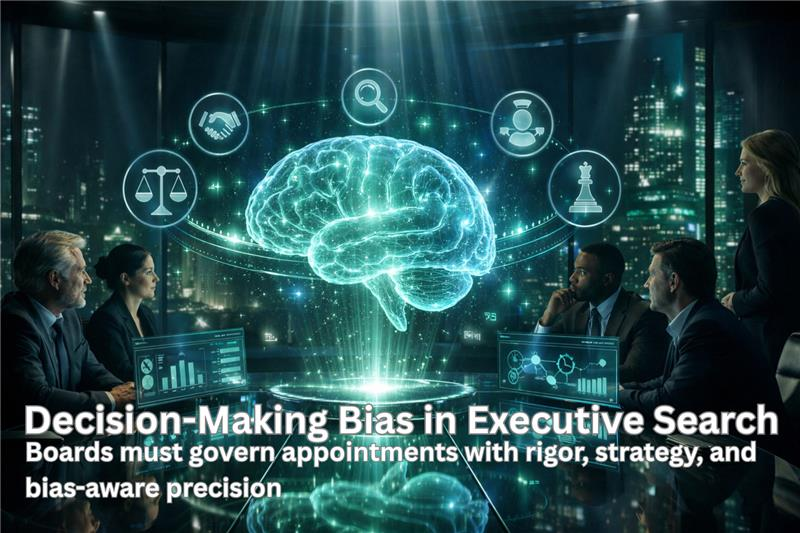
Executive search is one of the most consequential decisions a board will make.
Appointing a CEO, Chair or senior independent director shapes strategy,
culture, regulatory posture and long-term enterprise value.
Yet even highly experienced boards are not immune to cognitive bias.
In a climate defined by digital acceleration, regulatory intensity and investor scrutiny, disciplined and bias-aware
decision-making is no longer best practice, it is a governance necessity.
At
Wyman Bain, we support boards in designing executive search processes that are rigorous, strategically aligned and resilient to bias.
⚖️ Why Bias Intensifies at
Board Level
Executive appointments are often made under pressure, succession events, performance inflection points, activist attention or regulatory change.
Under such conditions, judgement shortcuts become more likely.
Left unaddressed, bias can lead to:
- Strategic misalignment between leadership capability and future direction
- Reinforcement of homogeneity in perspective and background
- Overreliance on familiarity rather than forward-looking competence
- Erosion of stakeholder confidence
The cost is rarely immediate, but it is often structural.
🔍 The Biases That Most Commonly Distort
Executive Search
1️Affinity Bias
A preference for candidates who mirror existing board profiles, in
education, career path or temperament.
This can limit diversity of thought and adaptive capacity.
2️Confirmation Bias
Once an early favourite emerges, boards may unconsciously seek validating information while discounting contrary evidence.
Unstructured interviews amplify this risk.
3️The Halo Effect
Exceptional performance in one domain can overshadow limitations in others.
Past success, particularly in stable environments, may not equate to capability in transformation.
4️Status Quo Bias
In uncertain times, “safe hands” can feel reassuring.
However, stability is not always synonymous with
strategic relevance.
5️Overconfidence Bias
Experience in governance can create confidence in intuitive judgement.
Yet chemistry and gravitas are not substitutes for measurable capability.
🏛️ The Governance Implications
Bias in executive search is not merely a human flaw, it is a governance risk.
It can constrain:
- Strategic agility
- Cultural evolution
- Regulatory preparedness
- Long-term value creation
In sectors facing technological disruption and continuous oversight, leadership precision must match strategic complexity.
🚀 Engineering a Bias-Resilient
Search Process
Boards can materially strengthen outcomes through structural discipline:
✔️
Future-State Mandate Definition
Define leadership requirements based on forward strategy, not legacy performance models.
✔️
Competency-Led Evaluation Frameworks
Adopt structured scoring systems aligned with enterprise priorities.
✔️
Constructive Challenge Culture
Encourage independent scrutiny and avoid premature consensus.
✔️
Diverse and Evidence-Based Shortlisting
Expand networks and test assumptions through data, not familiarity.
✔️
Process Review and Reflection
Evaluate not only the outcome, but the integrity of the decision pathway.
Objectivity is not accidental.
It is designed.
🧭 From
Appointment to Strategic Stewardship
Executive search represents a defining moment of board stewardship.
Boards that actively mitigate bias:
- Strengthen investor confidence 📈
- Enhance diversity of thought 🌍
- Improve resilience under scrutiny 🔐
- Align leadership capability with future risk and opportunity
Leadership excellence begins with decision discipline.
🤝 How
Wyman Bain Supports Boards
Wyman Bain partners with boards and investors to:
- Assess executive capability against forward-looking strategy
- Design bias-aware search and succession frameworks
- Benchmark board composition and governance maturity
- Align leadership selection with complex regulatory and digital landscapes
In executive search, the quality of the decision determines the quality of the future.
Bias cannot be eliminated entirely.
But with the right governance architecture, it can be controlled.
CONTACT US >>>>>>>>>>