
Why Risk Committees Miss Behavioural Risk ⚠️🧠
Why Risk Committees Miss Behavioural Risk ⚠️🧠
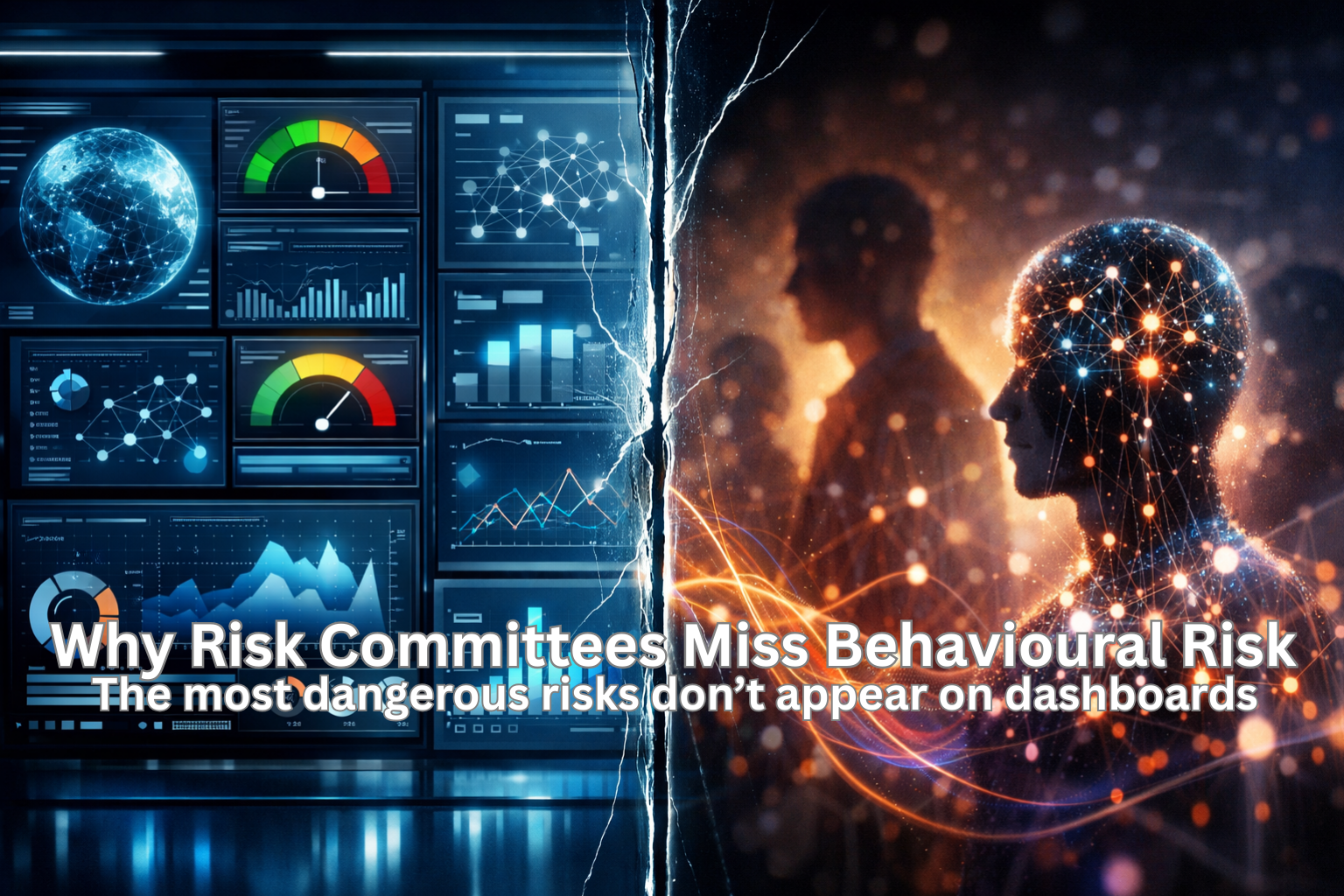
Risk committees are highly skilled at overseeing
financial, operational and regulatory risk. Dashboards are reviewed, controls assessed, and assurance carefully documented.
Yet many of the most damaging
organisational failures do not originate from weak controls or poor reporting. They originate from behaviour.
Behavioural risk, how people think, decide, challenge and respond under pressure is often the least visible, least owned and least governed risk of all.
Behaviour Doesn’t Sit Neatly on a Dashboard 📊
Risk governance naturally gravitates towards what can be measured. Capital ratios, incidents, audit findings and compliance metrics all provide comfort and structure.
Behavioural risk is different. It rarely produces early warning signals that fit neatly into reporting packs. Patterns of overconfidence, silence, excessive deference or urgency-driven decision-making are difficult to quantify, until they crystallise into failure.
By the time behavioural
risk appears in formal metrics, options are often limited and choices constrained.
Why “Tone at the Top” Is Not Enough 🎭
Many organisations rely heavily on leadership statements, values and tone from the top. While important, tone alone does not shape behaviour.
Behaviour is shaped by what is rewarded, tolerated and ignored:
- How challenge is received in senior forums
- Whether dissent is framed as contribution or delay
- How mistakes are discussed following strong results
When incentives, pressure and power dynamics contradict stated values, behaviour follows the reality, not the rhetoric.
When Success Masks Behavioural
Risk 🧩
Strong performance often reduces scrutiny. When results are positive, attention shifts from decision quality to delivery.
Success reinforces behaviour. Leaders rewarded for speed and certainty may stop testing assumptions or surfacing uncertainty. Over time, curiosity gives way to confidence and challenge fades.
The organisation becomes efficient, but brittle.
Behavioural Risk Lives Between Committees 🧠
Behavioural risk rarely has a natural home. It sits uncomfortably between risk, audit, people and remuneration committees.
As a result:
- Each committee sees only part of the picture
- Early warning signals are normalised or rationalised
- No forum feels fully accountable for intervention
What is everyone’s risk often becomes no one’s risk.
What Risk Committees Can Do Differently
Addressing behavioural risk does not require committees to become psychologists. It requires sharper judgement and better questions.
Effective risk committees ask:
- How are decisions made under pressure?
- Where is challenge strongest and where is it weakest?
- What behaviours are consistently rewarded?
- Where does performance rely on a small number of individuals?
These questions surface risks that dashboards cannot.
From Assurance to
Judgement 🏛️
The purpose of risk governance is not to eliminate uncertainty. It is to preserve judgement.
Committees that look beyond metrics and controls, and into behaviour are far better positioned to identify risk early, while meaningful choices still exist.
Behavioural risk may be uncomfortable to examine, but it is often the most decisive risk organisations face.
Final Thought 💭
If risk committees only govern what they can measure, they will consistently miss what matters most.
Behaviour is where risk first appears, long before it shows up in the numbers.
CONTACT US >>>>>>>>>