
🌍 Transforming UK Clinical, Critical & Special Needs Care
The Rise of Private Equity, Consolidation & Technology Driven Outcomes
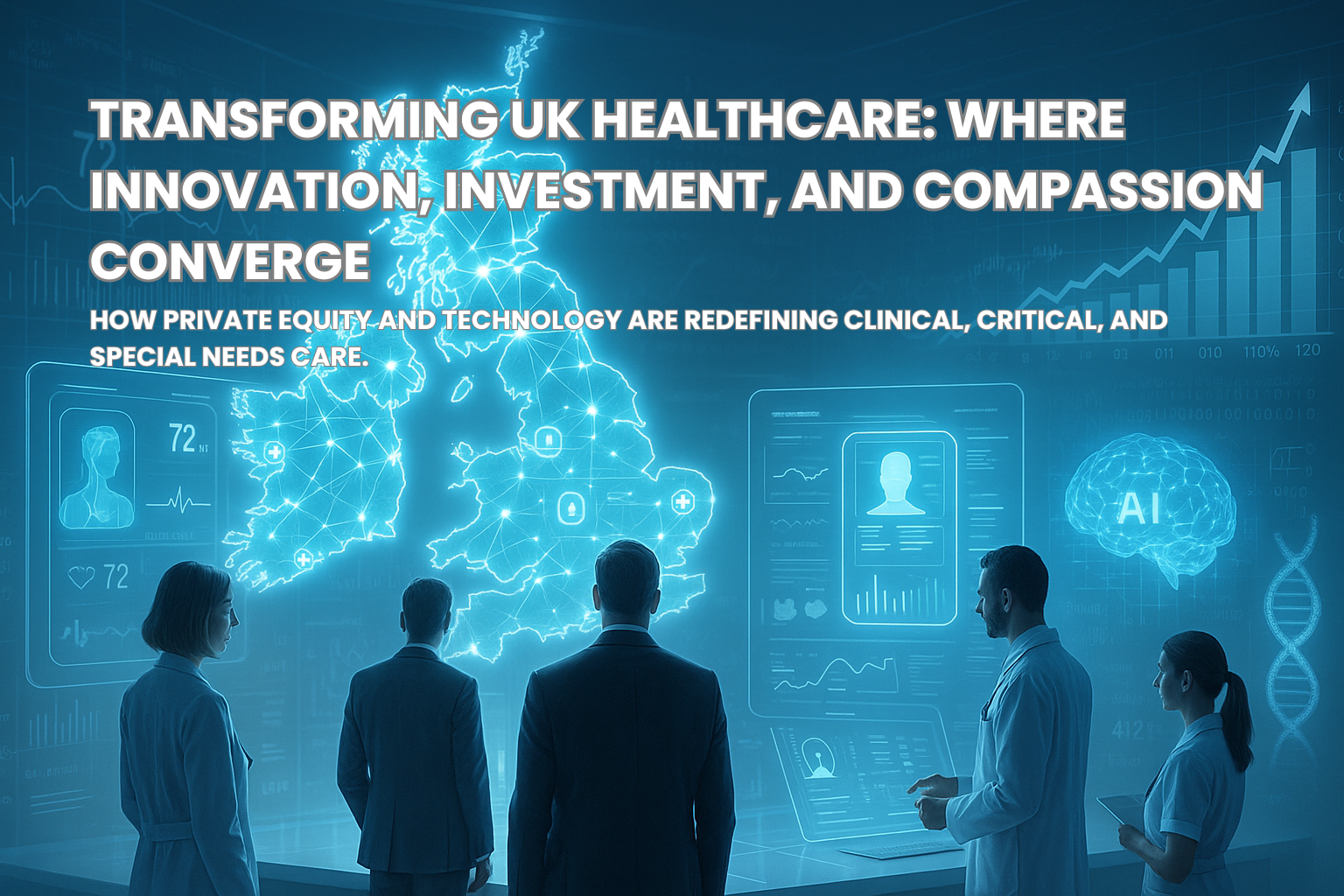
The UK healthcare landscape is experiencing a profound transformation. Across clinical, critical, and special needs care, traditional delivery models are evolving, driven by the combined forces of private equity (PE) investment, sector consolidation, and rapid technology adoption.
These shifts are not only redefining how care is delivered but are also enhancing patient outcomes and presenting new opportunities and challenges for healthcare providers and investors alike.
💷 Private Equity’s Expanding Role in UK Healthcare
Despite ongoing macroeconomic pressures and higher borrowing costs in 2025, private equity interest in the UK healthcare market remains remarkably strong.
According to AFS Law’s mid-2025 analysis, PE firms continue to channel capital into clinical and critical care providers, recognising the sector’s resilience, innovation, and growth potential. A parallel surge is evident in special needs care, where the demand for personalised, high-quality services continues to rise sharply.
PE-backed consolidation is reshaping the sector, with larger healthcare groups emerging through mergers and acquisitions.
These organisations benefit from:
✅ Economies of scale
✅ Enhanced operational capabilities
✅ Greater access to capital for
digital transformation and
workforce development
For instance, IMAP’s 2025 Healthcare Sector Update identifies clinical services and diagnostics as prime investment targets, reflecting the trend towards integrated care pathways.
However, with growth comes scrutiny. A 2023 BMJ study found that while PE ownership can drive efficiency, it also raises concerns about cost increases and care quality, particularly in vulnerable and special needs populations.
💻 Technology as a Catalyst for Better Patient Outcomes
Technology is revolutionising the UK’s approach to care, reshaping how providers engage with patients, optimise performance, and deliver results.
Key innovations include:
🤖
Advanced Diagnostics & AI – AI-powered tools are improving diagnostic accuracy and speed, critical in high-stakes
critical care environments.
📱
Remote Monitoring & Telehealth – Telemedicine and wearable technologies allow for continuous monitoring and
personalised treatment plans, reducing unnecessary hospital admissions.
📊
Data Analytics & Integration – Real-time analytics drive
proactive care,
resource optimisation, and
patient safety.
🧩
Accessibility Tools – From communication aids to sensory-friendly digital therapies, technology is empowering
special needs patients with more engaging and effective support systems.
According to Wecovr’s 2025 report, funding for digital health firms, especially those addressing chronic and special needs care, has surged, marking a major step towards tech-enabled, patient-centred medicine.
🌱 The Benefits of Consolidation & Innovation
When private equity investment meets technology adoption, both patients and providers gain.
Here’s how:
🏥
Improved Access – Larger, integrated healthcare groups can deliver broader service portfolios across regions.
🩺
Enhanced Quality & Safety – Digital records and monitoring systems reduce errors and support coordinated, multidisciplinary care.
💬
Better Patient Experience – Technology enables
personalised care journeys, especially vital in
special needs and
critical care environments.
⚙️
Operational Efficiency – Scale and automation streamline operations and improve resource use, key amidst ongoing
NHS capacity challenges.
🔍 Strategic Considerations for the Future
As outlined in the UK Government’s 10-Year Health Plan, private sector innovation and capacity will play a pivotal role in supporting NHS delivery and achieving sustainable care models.
For investors and providers alike, the challenge lies in balancing growth ambitions with ethical responsibility and patient-centred values, particularly in special needs care, where the stakes are highest.
Technology must be seen not merely as a cost-saving tool, but as a strategic enabler for improved outcomes, transparency, and accessibility.
🤝 How Wyman Bain Supports Healthcare’s Next Chapter
At Wyman Bain, we help healthcare providers and investors navigate this evolving landscape through executive search and market intelligence solutions tailored to the sector’s unique challenges.
Our
research-led approach identifies leaders who:
🌟 Understand the nuances of
clinical, critical, and special needs care
🌟 Drive
innovation while maintaining excellence in
patient outcomes
🌟 Thrive in
PE-backed, technology-driven environments
We also deliver
bespoke market intelligence projects providing insights into
talent availability,
compensation trends, and
competitive positioning across the UK healthcare ecosystem.