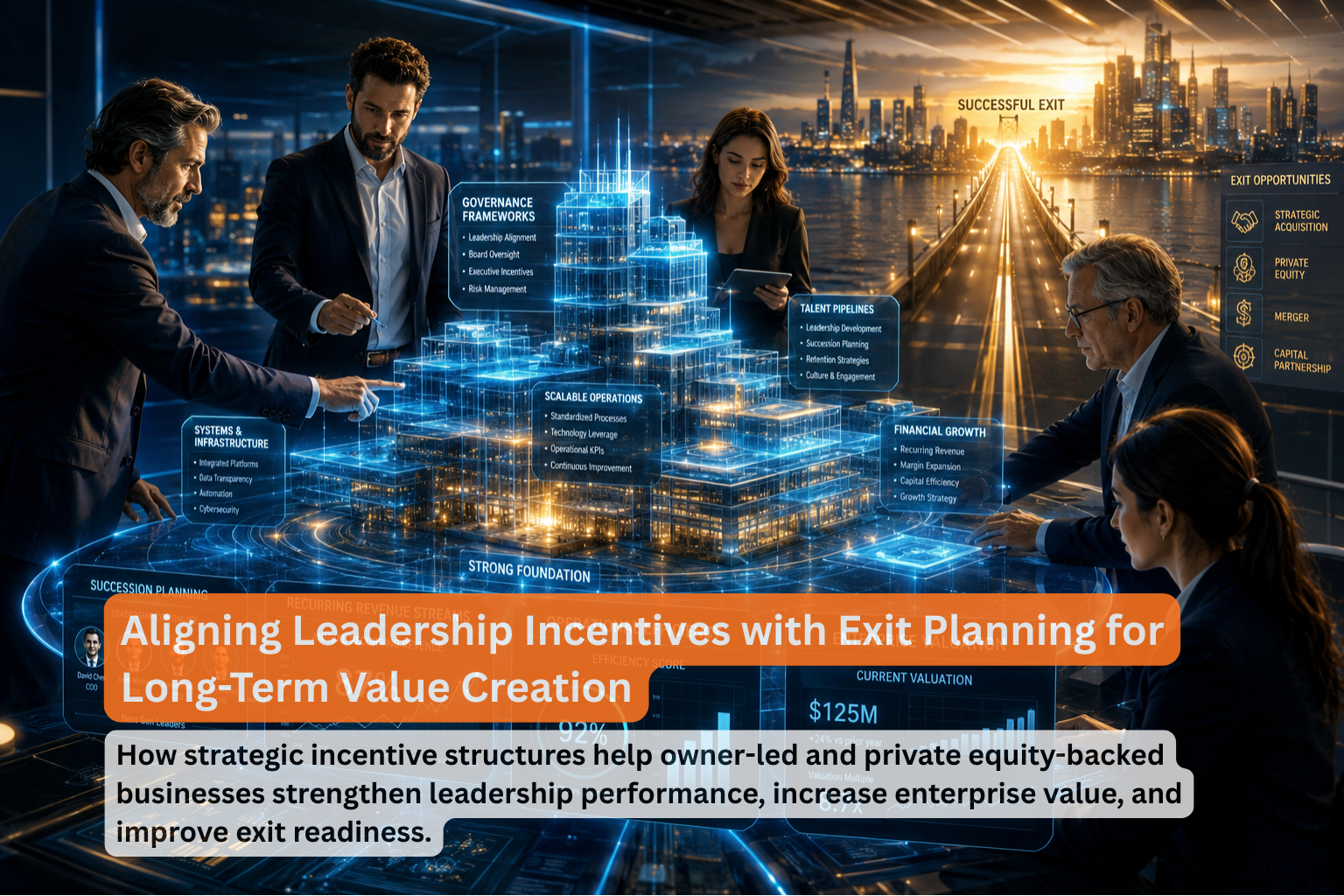
Aligning Leadership Incentives with Exit Planning 🚀
Aligning Leadership Incentives with Exit Planning 🚀
In professional services and owner-led or
private equity-backed businesses, leadership decisions are never just operational, they directly influence enterprise
value and eventual exit outcomes.
Whether the goal is a trade sale, private equity investment, or structured
succession, one principle consistently stands out:
leadership incentives must be aligned with exit planning to maximise long-term value.
At
Wyman Bain, we see this alignment as a defining factor in successful transitions and high-performing leadership teams. 🤝
Why alignment is critical 🎯
Leadership incentives are powerful behavioural drivers. They shape how executives prioritise growth, manage risk, invest in people, and build infrastructure.
When aligned effectively with exit planning, incentives encourage leaders to focus on:
- Sustainable revenue growth 📈
- Strong operational foundations ⚙️
- Scalable systems and processes
- Long-term client relationships 🤝
- Enterprise value creation rather than short-term gains
However, when misaligned, even high-performing leadership teams can unintentionally undermine exit value.
Common outcomes include:
- Over-prioritising short-term profitability over quality
- Delaying investment in talent or technology
- Weakening long-term scalability
- Creating inconsistent strategic direction ahead of exit
The link between incentives and valuation 📊
Exit value is not driven by financial performance alone, it is also influenced by predictability, scalability, and leadership depth.
Well-structured incentive frameworks help to strengthen valuation by encouraging:
- Recurring and resilient revenue streams 💼
- Reduced dependency on key individuals
- Strong governance and decision-making structures
- Improved operational efficiency and margin quality
- High-performing, autonomous leadership teams
When
leadership teams are incentivised to think like long-term owners, the business becomes significantly more attractive to buyers and investors.
Common misalignment
risks ⚠️
Many organisations only address incentive design late in the lifecycle, which can create structural challenges such as:
- Incentives linked purely to annual financial targets
- Lack of clarity around exit timing or structure
- Founder dependency at senior decision-making level
- Insufficient succession depth across key roles
- Misaligned short-term bonuses that conflict with long-term value creation
These issues can reduce buyer confidence and ultimately impact valuation and deal certainty.
What strong
alignment looks like in practice ✅
Leading organisations typically design incentive structures that reflect both performance and future value creation. This often includes:
- Long-term incentive plans linked to enterprise value growth 📊
- Balanced scorecards combining financial, operational, and strategic KPIs
- Clear succession planning embedded into leadership expectations 👥
- Shared understanding of exit objectives across the leadership team
- Reward systems that promote collaboration, scalability, and sustainability
Crucially, alignment ensures leaders are not only focused on today’s performance, but also on tomorrow’s exit readiness.
Exit planning as a continuous
discipline 🧭
Exit planning should not be treated as a final-stage transaction activity. Instead, it should be embedded into leadership strategy from the outset.
When leaders are aligned to the intended exit pathway, they can make more informed decisions around:
- Strategic investment priorities 💡
- Talent acquisition and leadership development 👔
- Operational scalability and infrastructure readiness 📈
- Governance, risk management, and reporting standards 🛡️
- Organisational structure and leadership succession
This proactive approach enhances both operational performance and eventual
market positioning.
Final thoughts 💬
Aligning leadership incentives with exit planning is not simply a financial mechanism, it is a strategic framework for building stronger, more valuable businesses.
When leadership behaviour, reward structures, and exit objectives are aligned, organisations are better positioned to deliver sustainable growth and successful transitions.
At
Wyman Bain, we specialise in identifying and securing leadership teams that are aligned with long-term value creation and exit success. 🌟
CONTACT US >>>>>>>>